
All Hail Mimas: Our ‘Death Star’ Moon
MessageToEagle.com – It’s not in a galaxy far, far away or even another star system — this alien world is right in our planetary backyard, a mere 900 million miles away in orbit around Saturn.
It’s called Mimas, and although it undeniably is a moon it does bear an uncanny resemblance to a certain well-known sci-fi space station.
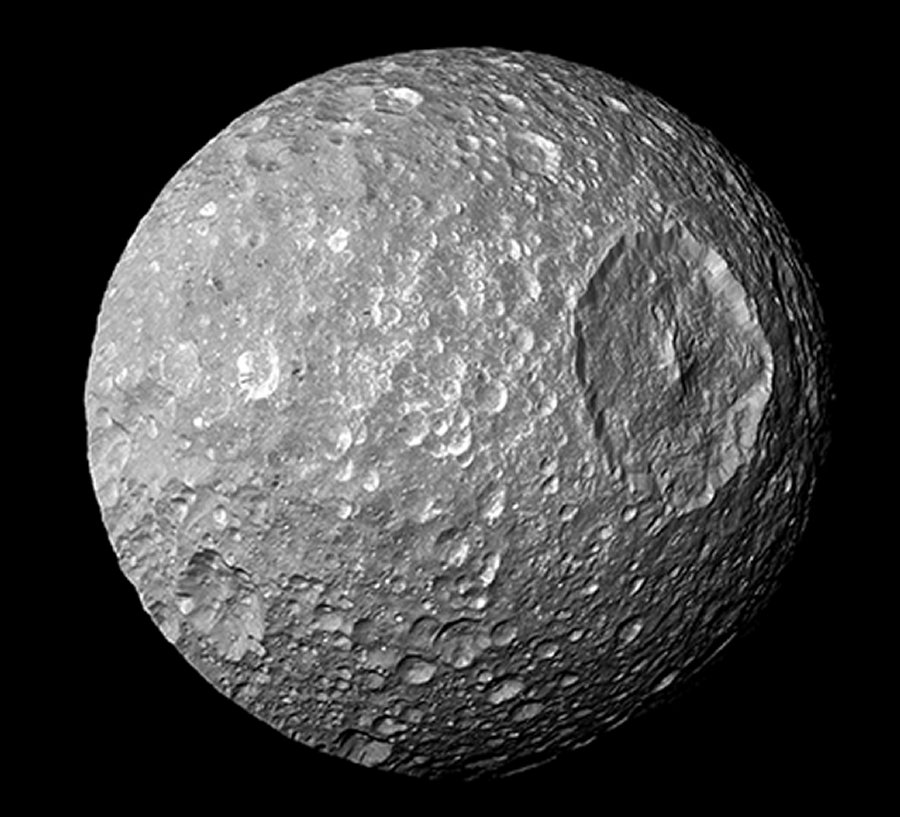
Credit: NASA/JPL/SSI
The image above was captured by NASA’s Cassini spacecraft on Feb. 13, 2010, and shows the hallmark of Mimas’ expert Star Wars cosplay: the (relatively) enormous Herschel crater on its northern hemisphere. Spanning 88 miles (140 km), Herschel is a full one-third the diameter of the 246-mile (396-km) wide moon, and with a prominent central peak it’s nearly a spot-on match for the Death Star’s infamous planet-killing superlaser cannon.
(Unlike the aforementioned, no Bothans were harmed in the obtaining of this data.)
In comparison if Earth were to have a crater of a relative size to Mimas’ monster Herschel, it would be 2,500 miles across — about the distance from New York City to Los Angeles!
Mimas is composed mostly of water ice and a small bit of rock. At its low surface temperature of -350 degrees Fahrenheit (-208 degrees Celsius) water is as hard as rock is here on Earth. Like its bigger sister moons Rhea and Dione, Mimas is covered with impact scars — it is literally one of the most heavily-cratered worlds in the solar system.
Unlike the similarly-sized Enceladus, though, Mimas lacks any current evidence of a subsurface ocean. Somehow its water has remained solidly frozen for a very long time despite being closer to to Saturn and having an even more eccentric orbit than Enceladus.
Scientists are still trying to determine why this is the case.
Discovered in 1789 by German astronomer William Herschel, Mimas orbits Saturn at an average distance of 115,277 miles (185,520 km) — about half the distance that our moon is from us.
And if you simply must have the comparison, the very real Mimas is — according to the resource site Wookieepedia — about 100 miles (160 km) wider than the fictional Death Star(s) of the Star Wars universe.
It may lack laser turrets or a planet-destroying cannon but it’s also well without any poorly-placed thermal exhaust shafts and, long after the destruction of the Galactic Empire, Mimas is still around.
Source: NASA/JPL
MessageToEagle.com via Discovery News
This article was originally published on Discovery News – a site dedicated to satisfying your curiosity and to bringing you mind-bending stories and perspectives you won’t find anywhere else.
Related Posts
-
 Terrorism Of Today Predicted In Times Past? Mother Shipton, Nostradamus And Other Heralds
-
 Collision Course Established: Milky Way – Andromeda In Head-On Crash
-
 Nascent Gas Giant Planets May Be Lurking In Dusty Disk
-
 Amasia – New Future Supercontinent
-
 Planets In L 98-59 Exoplanet System Resemble Those In The Inner Solar System
-
 How Did Mars Get All Of Its Clouds? – Meteors Are Involved In The Process
-
 Primordial Black Holes Might Be Hidden In Planets Or Everyday Objects On Earth
-
 Wide And Sharp 3D Dark Matter Map Created – Important Step To Better Understand Accelerating Expansion Of The Universe
-
 Strange Slime Mold Behavior Used To Map Hidden Web Of Universe’s Dark Matter
-
 First Gamma-Ray Pulsar Detected In Another Galaxy

