
Atmospheric Differences Between The Morning And Evening Sides Of The Ultrahot Gas Planet WASP-121 b
Eddie Gonzales Jr. – MessageToEagle.com – Observations with the James Webb Space Telescope (JWST) reveal stark differences between the morning (dawn) and evening (dusk) sides of the ultrahot Jupiter WASP-121 b.
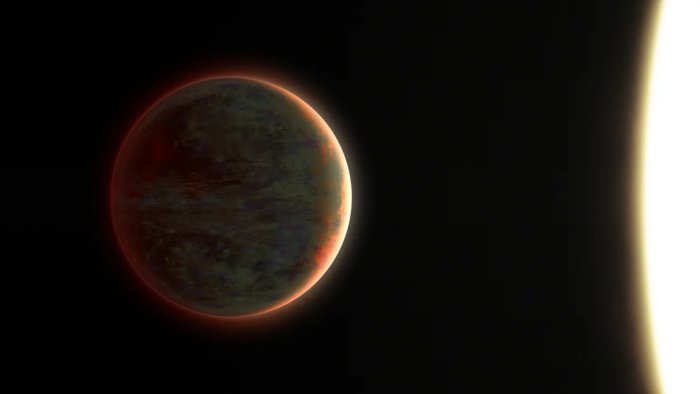
Artist’s impression of the exoplanet WASP-121 b. It belongs to the class of hot Jupiters. Due to its proximity to the central star, the planet’s rotation is tidally locked to its orbit around it. As a result, one of WASP-121 b’s hemispheres always faces the star, heating it to temperatures of up to 2500 degrees Celsius. The night side is always oriented towards cold space, which is why it is 1775 degrees Celsius cooler there. Image credit: Patricia Klein and MPIA
Confirmation of variations between dusk and dawn
The discovery corresponds to an asymmetry in the absorption of infrared light received from the host star, which is partially filtered through the planet’s atmosphere during its transit. The researchers interpret this as the result of non-uniform temperatures and chemical compositions in the exoplanet’s atmosphere.
The data indicate that the evening terminator absorbs more light than the morning side, consistent with the commonly accepted picture of powerful winds that transport intense heat from the day to the night side. Hot winds follow the planet’s rotation eastward, which heats the evening zone. With rising temperatures, this region is bound to expand, increasing the planet’s cross-section and allowing it to absorb stellar radiation more efficiently.
Besides a general slight reduction in brightness towards the end of the transit, the data obtained by JWST’s NIRSpec (Near-infrared spectrograph) instrument also reveal an increase in the carbon monoxide (CO) signal. However, this appears to be a temperature effect, not related to an increase in carbon monoxide molecules.
In contrast, the amount of water (H2O) in the atmosphere appears to drop, which the astronomers interpret as a real decrease in water molecules. The temperatures in the upper atmosphere are high enough to break water molecules into their constituents. This result again corroborates the existence of hot winds heating the evening terminator region.
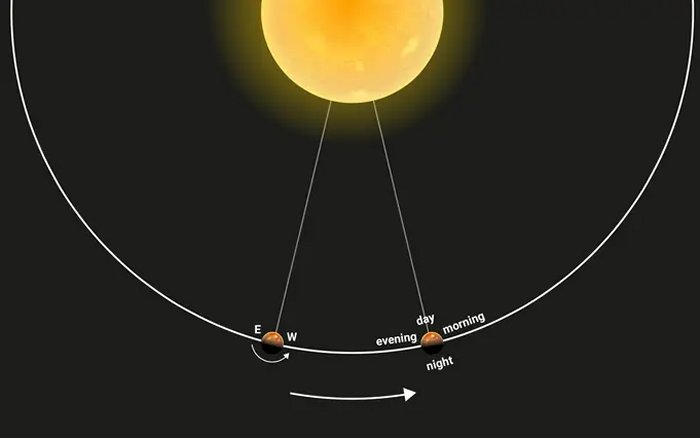
To detect these minute variations, the astronomers exploited a peculiar behaviour of hot gas planets. The proximity to their host stars slowly synchronizes their spin and orbital motion via tidal forces, such that eventually one rotation takes as long as one revolution. Finally, these planets exhibit two distinct hemispheres: a hot side constantly facing the star and an opposite, darker and cooler side.
“WASP-121b is particularly extreme, with average temperatures on the dayside hemisphere being around 2770 Kelvin, while those on the nightside are closer to about 1000 Kelvin,” co-author Tom Evans-Soma from the University of Newcastle, Australia, explains. He previously determined the planet’s temperature range and is also affiliated with MPIA. These values translate to almost 2500 degrees Celsius, or about 4525 degrees Fahrenheit, on the dayside, and approximately 725 degrees Celsius, or 1340 degrees Fahrenheit, at night.
When astronomers observe such a planet transiting in front of a star, the planet rotates slightly between the points of ingress and egress, revealing different fractions of its atmosphere. While the planet mostly presents its night side, our point of view permits glimpses beyond the dusk and dawn towards the bright dayside, depending on the transit’s progress. The zone leading the planet’s orbit corresponds to the morning side, and the one trailing is the evening side.
Apart from recording the measured brightness variation over time, spectrographs break light into smaller components, which physicists call a spectrum, much as a prism produces a rainbow-like distribution of colours. Since atmospheric gases absorb light at distinct colours or wavelengths, a detailed analysis reveals their chemical composition.
Elapsed time converts to longitude
Hence, the variation along the direction of rotation translates into a time-dependent change of the filtered signal. In the case of WASP-121 b, the rotation angle during a full transit amounts to about 30 degrees, which is sufficient to probe the morning (dawn) and evening (dusk) terminators with high precision in longitude.
Astronomers usually average the measurements over the entire transit to achieve a clearer signal. However, to determine how the signal changes during the planet’s trajectory across the star, Gapp and his colleagues allowed for a temporal variation while the planet rotates. By applying statistical methods, they found that their procedure provides a significantly better fit to the data, indicating that they indeed detected a significant variation.
Notable gaps in atmospheric models
To verify the measured temperatures that would cause local expansion, the astronomers ran models simulating heat distribution in the upper layers of a gas planet, depending on the planet’s properties and the constellation of the planet and its host star. While these atmospheric models confirmed the asymmetric effect caused by spatial temperature variations, the data revealed a larger signal amplitude than the models predicted.
The astronomers suspected that cooling mechanisms at the morning terminator might be at work that the models didn’t account for. Previous studies have indicated that clouds may be present, albeit composed not of water droplets but of minerals such as silicates. Clouds can efficiently shield infrared light emitted from hot gaseous layers below, mimicking lower temperatures. Infamously, simulating the physics of clouds, condensation, and evaporation in a dynamic environment is hard. Therefore, physical models commonly applied to exoplanet atmospheres, such as the one used in this study, do not account for clouds, which can yield unrealistic results.
After tweaking the simulation to better approximate the effect of clouds on infrared radiation from deeper layers, the results were more consistent with observations. However, only more sophisticated models will be able to confidently confirm the presence of clouds.
A blueprint for future studies
Model updates will also improve future studies. The astronomers have already identified more suitable targets with the right temperatures and spin rates to study the boundary regions. This will help them create a group of ultrahot gas planets, reveal their longitudinal structure, and possibly identify similarities and differences among these extreme worlds.
Written by Eddie Gonzales Jr. – MessageToEagle.com Staff Writer
Related Posts
-
 Critical Clue About The Life Cycles Of Binary Stars – Detected
-
 Hubble Finds Evidence Of Persistent Water Vapor In One Hemisphere Of Europa
-
 Mind-Blowing View: Total Lunar Eclipse Looks Like From The Moon – Video From NASA
-
 Why Do Galaxies Stop Making Stars? A Huge Collision In Space Provides New Clues
-
 Researchers Used Extinct Atom To Date Events That Took Place In The Early Solar System
-
 Dunelands Of Titan – NASA’s Cassini Spacecraft Delivers A New Image
-
 Unknown Planet-Sized Object Is Hiding Beyond Pluto – Is Planet 10 Responsible For The Warped Kuiper Belt?
-
 Unmatched Collection Of Oscillating Red Giant Stars – Detected
-
 Cosmic Milestone: NASA Confirms 5,000 Exoplanets
-
 First Image Of A Sunspot – Released

