
CoRoT-7b – Alien World That Contributes To The Vision Of Hell
MessageToEagle.com – There is a strange alien planet orbiting an orange dwarf star in the constellation Monoceros bordered by the constellations of Canis Minor, Gemini, Hydra, Lepus, Orion and Puppis and located 490 light years away.
Detected by the CoRoT satellite in 2009, CoRoT-7b is the smallest, (with diameter of only 1.58 times that of the Earth and fastest-orbiting exoplanet yet discovered.
The smaller the orbit, the faster the planet circles its star, and therefore CoRoT-7b travels at more than 750,000 kilometers per hour!
Astronomers detected the new planet as it transited its parent, a Sun-like star, dimming the light from the star as it passed in front of it.
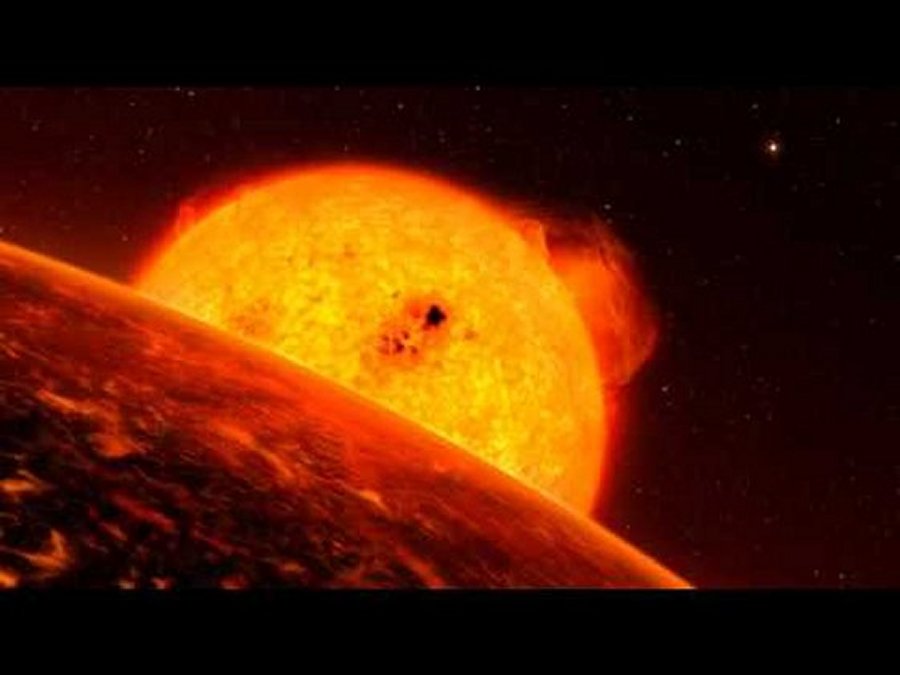
The discovery gave some hope about its density, which was under investigation.
Was this rocky body similar to Earth or a class of planets which are thought to be made up of water and rock in almost equal amounts?
Given the high temperatures measured, the planet would be a very hot and humid place.
However, the planet’s “true” face was unknown until astronomers led by Professor Bruce Fegley from Washington University, began to model the alien planet’s atmosphere.
The planet’s extreme conditions make that it cannot sustain life or most probably any life at all.
CoRoT-7b is a hellish world – too hot for any life. There is no water cloud forming and water droplets raining on the planet’s hot surface.
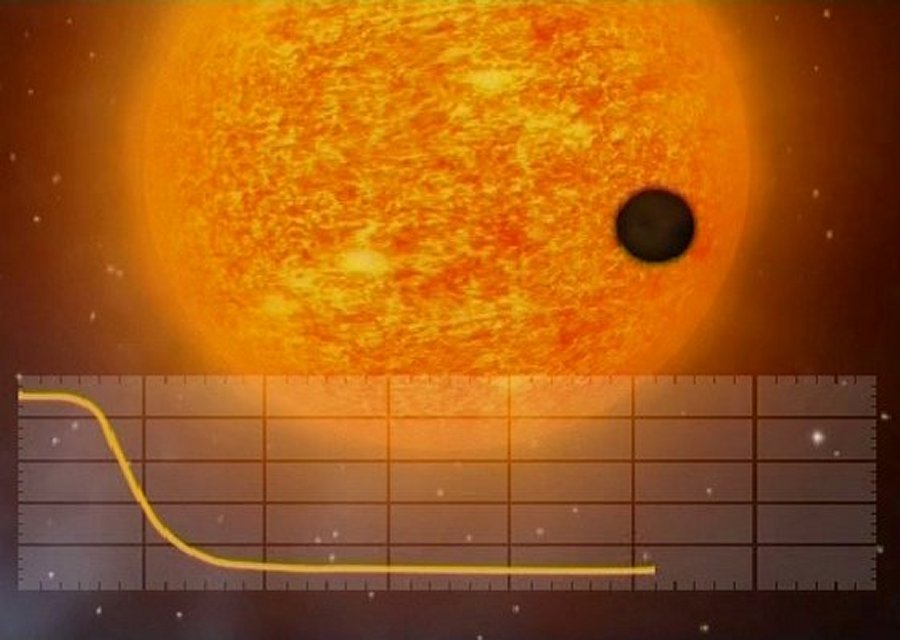
Astronomers who have worked on computer models to create an exotic environment of this alien world say that a rain of pebbles falls from clouds of rock vapour into lakes of molten lava and the exoplanet’s surface, covered with boiling oceans, has temperature which is hot enough to boil rock.
The planet is only 1.6 million miles from its star, which means 23 times closer than the innermost planet in our solar system, Mercury, is to the Sun.
Due to its location, (only 2.5 million kilometers from its host star) the planet planet is gravitationally locked, like the Moon to the Earth, so that one side of the planet always faces the star. CoRoT-7b’s far side is in never ending darkness – around 50 degrees above absolute zero, while its near side experiences 2,800C.
“CoRoT-7b is so close that the place may well look like Dante’s Inferno, with a probable temperature on its ‘day-face’ above 2,000 degrees and minus 200 degrees on its night face,” says Didier Queloz, who led the team that made the CoRoT-7b discoveries.
CoRot-7b is perhaps Earth-like object but it’s definitely not like our planet and will never be!
MessageToEagle.com
Expand for referencesRelated Posts
-
 Stationary Telescope Inside The Moon’s Crater – Astronomers Revive A Decade-Old Idea
-
 Search For The Missing Gravitational Signal
-
 Coldest Star Yet That Emits Radio Waves – Identified
-
 ‘Dark Matter, Not A Black Hole, Could Power Milky Way’s Heart’
-
 Weird, Intriguing Hot Jupiter CoRoT-2b With Winds Blowing In Wrong Direction
-
 New Previously Undiscovered Volcano On Jupiter Moon Io – Spotted By NASA’s Juno
-
 Hubble Inspects Two Galaxies Connected By A Luminous Bridge
-
 El Niño And Its Effects On The Planet
-
 Could A Twin Earth Detect Earth? What Does Earth Look Like To The Rest Of The Galaxy?
-
 Uncovering Evidence For An Internal Ocean In Small Saturn Moon

