
Elusive Ultra Metal-Poor Star 2MASS J18082002–5104378 B Is One Of Oldest In Universe
MessageToEagle.com – Astronomers at Johns Hopkins University have found what could be one of the universe’s oldest stars, a body almost entirely made of materials spewed from the Big Bang.
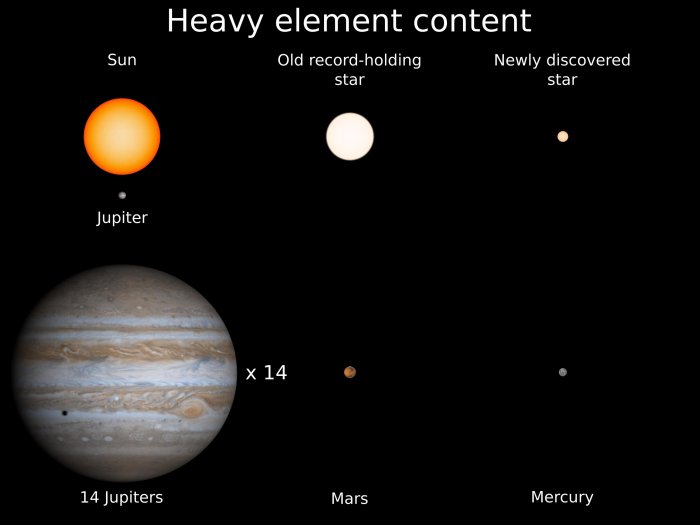
The tiny star named 2MASS J18082002–5104378 B, is approximately 13.5 billion-year-old and has very low mass and very low metal content. The star is unusual because, unlike other stars with very low metal content, it is part of the Milky Way’s “thin disk”—the part of the galaxy in which our own sun resides.
It’s possible that our galactic neighborhood is at least 3 billion years older than previously thought, researchers say.
“This star is maybe one in 10 million,” Kevin Schlaufman, an assistant professor of physics and astronomy and lead author of the study, said in a press release.
“It tells us something very important about the first generations of stars.”
The newly discovered star system orbits the galaxy on a circular orbit that, like the orbit of the sun, never gets too far from the plane of the galaxy. The star’s extremely low metallicity indicates that, in a cosmic family tree, it could be as little as one generation removed from the Big Bang.
Astronomers have found around 30 ancient “ultra metal-poor” stars with the approximate mass of the sun. The star Schlaufman and his team found, however, is only 14 percent the mass of the sun.
The star is part of a two-star system orbiting around a common point. Schlaufman and his team found the tiny, almost invisibly faint “secondary” star after another group of astronomers discovered the much brighter “primary” star. They also identified unusual behavior in the star system that implied the presence of a neutron star or black hole.
The existence of the smaller companion star turned out to be the big discovery. Schlaufman’s team was able to infer its mass by studying the primary star’s slight “wobble” as the little star’s gravity tugged at it.
As recently as the late 1990s, researchers believed that only massive stars could have formed in the earliest stages of the universe—and that they could never be observed because they burn through their fuel and die so quickly.
The discovery of this new ultra metal-poor star, named 2MASS J18082002–5104378 B, opens up the possibility of observing even older stars.
“If our inference is correct, then low-mass stars that have a composition exclusively the outcome of the Big Bang can exist,” said Schlaufman, who is also affiliated with the university’s Institute for Data Intensive Engineering and Science. “Even though we have not yet found an object like that in our galaxy, it can exist.”
MessageToEagle.com
Related Posts
-
 Dragonfly Mission To Titan: Might Saturn’s Moon Host Some Kind Of Life?
-
 New Methods Will Allow For Better Tests Of Einstein’s General Theory Of Relativity Using LIGO Data
-
 Stunning Echo Of An 800-Year-Old Explosion
-
 On April 7, NASA’s OSIRIS-REx Mission Says Farewell To Asteroid Bennu Before Departing For Earth
-
 Strong Winds Around Black Holes Largely Affect Their Environment – New Study
-
 Hubble Uncovers Unique Features Around A Neutron Star
-
 Hubble Space Telescope Fixed After Month Of No Science
-
 Evidence Of Recent Clay Formation On Red Planet – Found
-
 Sharp, Blade-Like Structures Almost 15 m High On Europa – Problem For Spacecraft To Land
-
 Water On Asteroid Bennu – Discovered

