
Fantastic Biological Street Lighting: Using Glowing Plants And Trees As An Energy Source
MessageToEagle.com – Will glowing trees replace street lamps in the near future? Can glowing plants be used as a source of light?
These questions have occupied a group of scientists who have come up with an ingenious idea how to cut electricity costs and reduce light pollution.
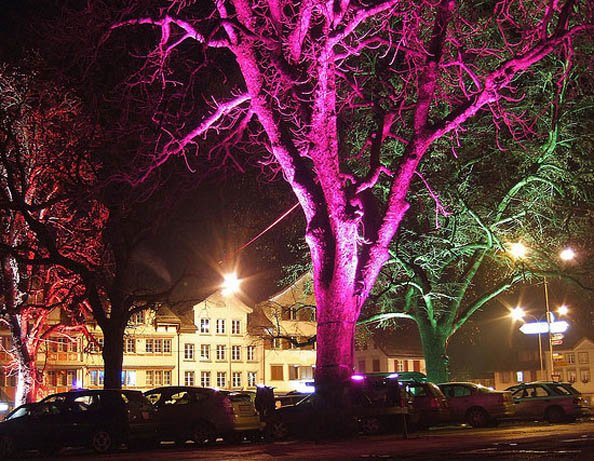
Walking down the street a late evening you might actually find yourself surrounded by amazingly beautiful glowing trees and pants, instead of ordinary street lamps.
Researchers say that after proper optimization, thees and plants can be used to construct biological street lightning and serve as an efficient energy source.
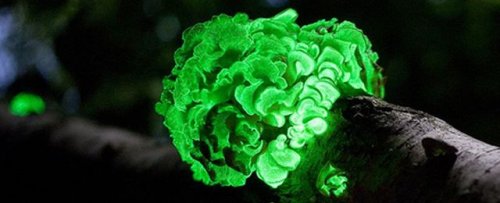
A group of researchers in Taiwan led by Yen Hsun Su and colleagues at Academia Sinica in Taipei and the National Cheng Kung University in Taiwan have successfully synthesized gold nanoparticles and implemented them into leaves of Bacopa caroliniana plant to induce bioluminescence in them.
This process turned the leaves into bio-light-emitting diodes.
Nanoparticles are particles with a diameter of about 10 nanometers ( a nanometer is a billionth of a meter).
Bacopa caroliania is a perennial aquatic or semi-aquatic herb commonly used as aquarium plant.” The color of the leaves varies in proportion to the amount of light, turning bronze to almost red when exposed to high light levels.”
“The green pigment in leaves, chlorophyll, is bioluminescent when exposed to high wavelength (400 nanometers (nm)) ultra violet excitation, but the wavelength is much shorter for the photoluminescence of gold nanoparticles, and they emit light at 400 nm.
The light is localized at a nanoscale and the nanoparticles made by the Taiwan team suppresses emission blinking, which is a problem already known in gold nanoparticles. Using their sea-urchin-shaped nanoparticles (dubbed nano-sea-urchins or NSUs), Su was able to excite chlorophyll in the leaves to emit red light.”
During the experiments scientists also discovered a relationship between the size of the gold particle and the intensity of the bioluminescence.
The larger particle, the more the leaf was shining.
Yen Hsun Su and his colleagues are now trying to apply the same technique to other plant molecules.
They are also determined to improve the efficiency of the process.
See also:
‘Artificial Trees’ Will Absorb Carbon Dioxide 1,000 Times More Effective Than An Regular Tree
Although the idea of using plants as sources of light may appear to be pure science fiction, Su and his team have successfully proved the idea is based on science and not fiction.
Su believes that bio-light-emitting diodes might eventually be used to make trees lining roads luminescent at night. Since the light causes the chloroplast to conduct photosynthesis no energy source is needed and the plant will absorb CO2 for the process, which does not normally occur at night.
Plants and trees which posses the ability to glow in the dark may provide us with new energy sources in the near future.
First version of this article was originally published on April 22, 2012
MessageToEagle.com
Related Posts
-
 Tarantula’s Blues And Greens May Be Used To Communicate, Attract Or Conceal
-
 Mysterious Ancestor Of All Mammals Identified Through Genome Reconstruction
-
 Door To Hell In Turkmenistan: Giant Darvaza Crater Has Been On Fire For Years
-
 This Woman Feels No Pain Because Of A Mutation In A Previously-Unidentified Gene
-
 Auroras On Alien Worlds Can Be Stunningly Beautiful
-
 Exoplanet HD 189733b Is Facing Wind Speed Of 5,400 Miles Per Hour
-
 An Unknown Bird Dated To Jurassic Period And Capable Of Flight
-
 Surprisingly Rapid Decline Of Neo-Assyrian Empire Still Baffles Researchers
-
 Opening Pandora’s Box: 30,000-Year-Old ‘Giant’ Virus To Be Brought Back To Back To Life By Scientists
-
 Millions Of Bizarre Luminous Creatures Invade The West Coast In U.S And No-One Knows Why

