Cosmic Mystery: How Giant Galaxies Could Form Just 1.4 Billion Years After The Big Bang
Eddie Gonzales Jr. – MessageToEagle.com – A surprising observation has puzzled astronomers for two decades. Massive and evolved galaxies already existed just a few billion years after the Big Bang.
Researchers expected to only find galaxies with young stars and ongoing star formation so early in the history of our Universe. Instead, there are many elliptical galaxies with older stellar populations and very little cold gas to form new stars. These observations pose a challenge to models of cosmological structure formation.
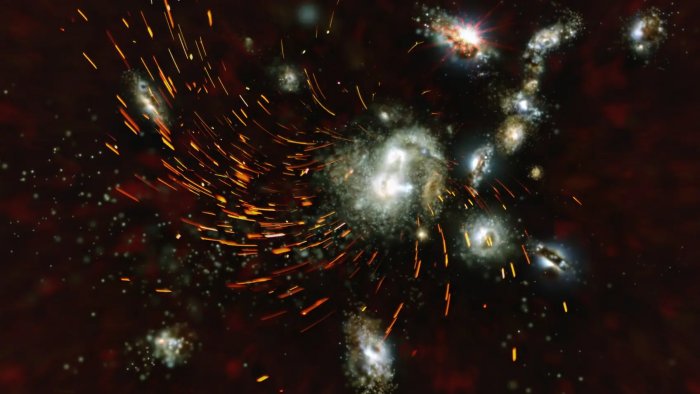
Clusters of young galaxies in the early Universe that later grow into large clusters are called protoclusters. This artist’s impression of the protocluster SPT2349-56 shows interacting galaxies of different shapes and sizes, and gas (orange) that is torn apart and heated by tidal forces. Due to its great distance from Earth, we see SPT2349-56 as it looked only 1.4 billion years after the Big Bang, when the Universe was 10% of its current age. © N.Sulzenauer, MPIfR
Formation of giant galaxies shortly after the Big Bang
The collisions of galaxies only 1.4 billion years after the Big Bang, which pulled each other apart in a close cluster due to their mutual gravitational attraction, led to the collapse of the entire core of the young galaxy cluster.
The group led by MPIfR astronomers now made a big leap in understanding these systems.
“In a Universe where larger galaxies grow hierarchically through gravitational interactions and mergers of smaller building-blocks, some giant ellipticals must have formed completely differently than previously thought. Instead of slowly assembling mass throughout 14 billion years, a massive elliptical galaxy might swiftly emerge in just a few hundred million years. It can form through the collapse and coalescence of a major primordial structure, in the time it takes the Sun to orbit around the Milky Way’s center once”, explains Nikolaus Sulzenauer, PhD researcher at the MPIfR and University of Bonn, and first author leading the analysis.
“We find that the structures with the very highest densities must have decoupled first from the Universe’s expansion at only 10 percent of the current cosmic age, and then rapidly assembled entire protoclusters.” For as space expanded, the first gas-filled structures that had permeated space at that time also drifted apart. The compression of gas sparks a cosmic firework, prodigiously bright as it is heated by star-birth activity. It is a beacon at far-infrared to millimeter wavelengths and thus accessible by observatories like ALMA and the Atacama Pathfinder Experiment (APEX).
Observing a Transformation
The team observed the cold gas and dust in the center of SPT2349-56, a protocluster seen just 1.4 billion years after the Big Bang and located in the southern constellation Phoenix. SPT2349-56 enables a rare glimpse of the first clusters, the main hubs of massive elliptical galaxies. “SPT2349-56 holds the record for the most vigorous stellar factory”, remarks Axel Weiß, who was also involved in the original discovery of SPT2349-56 with APEX. “In the center, we found four tightly-interacting galaxies forging one star every 40 minutes,” adds Ryley Hill from the University of British Columbia (UBC) in Canada. For comparison, it currently takes a whole year for three or four stars to form in the Milky Way.
“Importantly,” notes Sulzenauer “this galaxy quartet launches coherent giant tidal arms at 300 kilometers per second, stretching over an area much larger than the Milky Way. They glow intensely at submillimeter wavelength, their brightness boosted ten-fold by shock-waves exciting ionized carbon atoms. This bright emission allowed us to precisely measure the motion of gas in this gravitationally ejected spiral, resembling beads on a string encircling the protocluster core.
To our surprise, clumps of tidal debris link to a chain of 20 additional colliding galaxies in the outer parts of the collapsing structure. This hints at a common origin. For the first time, we are witnessing the onset of a cascading merging transformation. Most of the 40 gas-rich galaxies in this core will be destroyed and will eventually transform into a giant elliptical galaxy within less than 300 million years – a mere blink of an eye.”
Understanding How Galaxy Clusters Form
Duncan MacIntyre and Joel Tsuchitori, two UBC undergraduate students and part of the team, ran detailed numerical simulations. These were essential to bridge observations of this protocluster collapse with previous studies of mature galaxy clusters. The striking match between the different types of objects, found at different cosmic times, might not just demonstrate the importance of simultaneous major mergers during massive galaxy formation. It may also help to explain how heavy elements (such as carbon) are heated and transported throughout the first galaxy clusters.
“While our findings offer exciting new insights into rapid elliptical galaxy assembly, the various interactions between the merger shocks, gas heating from the growth of supermassive black holes, and their effect on the fuel for star-formation, remain big mysteries,” remarks Scott Chapman of Dalhousie University. “It might be too early to claim a full understanding of the ‘early childhood’ of giant ellipticals, but we have come a long way in linking tidal debris in protoclusters to the formation process of massive galaxies located in today’s galaxy clusters.”
Written by Eddie Gonzales Jr. – MessageToEagle.com Staff Writer
Related Posts
-
Water Plumes On Europa: Tasting An Extraterrestrial Ocean
No Comments | Dec 7, 2018 -
WFIRST: New NASA Mission Will Be Continuously Monitoring 100 Million Stars At The Center Of The Galaxy
No Comments | Feb 26, 2019 -
Is It Possible That Alien Worlds Orbit A Supermassive Black Hole?
No Comments | Nov 27, 2019 -
Searching For Signs Of Life Around The Dead Stars – New Study
No Comments | Jul 21, 2021 -
Great Ancient And Modern Thinkers Wonder: Is The Universe Infinite?
No Comments | Jun 30, 2016 -
Kuiper Belt Object Ultima Thule Unveils The Very First Stages Of Solar System’s History
No Comments | Jan 3, 2019 -
How Much Does Our Galaxy Weigh? Hubble And Gaia Investigate
No Comments | Mar 11, 2019 -
Hubble Spots Most Distant Single Star Ever Seen At A Distance Of 28 Billion Light-Years
No Comments | Mar 31, 2022 -
Giant Black Hole Explosion In Space: 100 Times Higher Than The Total Power Output Of The Milky Way Galaxy!
No Comments | Nov 28, 2012 -
Astronomers Have Identified A Supermassive Black Hole In Motion
No Comments | Mar 13, 2021