
Icy Barnard b Super-Earth Planet May Harbor Primitive Life If Geothermal Activity Exists
MessageToEagle.com – Barnard b (or GJ 699 b) is a recently discovered Super-Earth planet orbiting Barnard’s Star, making it the second nearest star system to the Earth.
Although likely cold (-170 degrees centigrade), it could still have the potential to harbor primitive life if it has a large, hot iron/nickel core and enhanced geothermal activity.
“Geothermal heating could support “life zones” under its surface, akin to subsurface lakes found in Antarctica,” Villanova University Astrophysicists Edward Guinan, said in a press release.
“We note that the surface temperature on Jupiter’s icy moon Europa is similar to Barnard b but, because of tidal heating, Europa probably has liquid oceans under its icy surface.”
Spotted using data from a global array of telescopes, the dimly lit world is the second-closest known exoplanet to Earth.
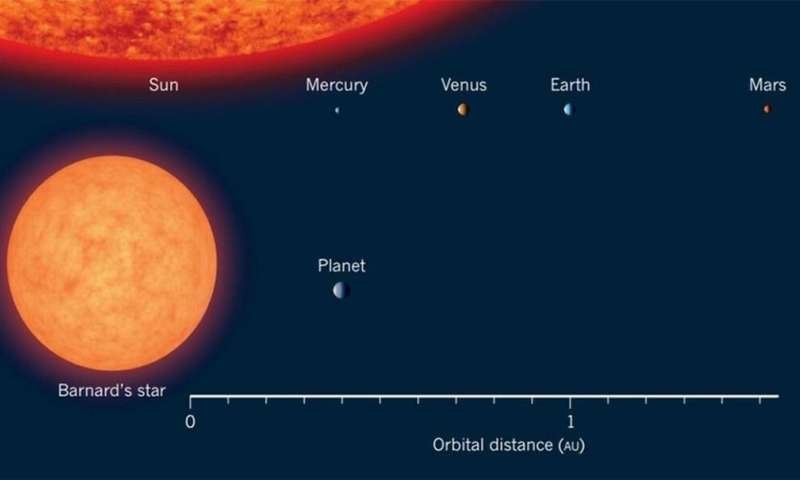
Barnard’s Star b, with a mass just over three times that of the Earth, orbits Barnard’s Star, a red dwarf star, every 233 days and at roughly the same distance that Mercury orbits the Sun. It passes near the dim star’s snow line.
Guinan and Engle have obtained high-precision photometry of Barnard’s Star (as well as dozens of other stars) for the past 15 years. Although very faint, it may be possible for Barnard b to be imaged by future very large telescopes, according to Guinan.
“Such observations will shed light on the nature of the planet’s atmosphere, surface, and potential habitability,” he added.
“Barnard’s Star has been on our radar for a long time,” Guinan said. “In 2003 it became a founding star member of the Villanova ‘Living with a Red Dwarf’ program that has been sponsored by the National Science Foundation/National Aeronautical and Space Administration (NASA).
“The most significant aspect of the discovery of Barnard’s star b is that the two nearest star systems to the Sun are now known to host planets. This supports previous studies based on Kepler Mission data, inferring that planets can be very common throughout the galaxy, even numbering in the tens of billions,” Ignasi Ribas, Director of the Institute of Space Studies of Catalonia (IEEC), and Institute of Space Sciences (ICE, CSIC), noted.
“Also, Barnard’s Star is about twice as old as the Sun – about 9 billion years old compared to 4.6 billion years for the Sun. The universe has been producing Earth-size planets far longer than we, or even the Sun itself, have existed.”
MessageToEagle.com
Related Posts
-
 How Do Galaxies Evolve? Possible Missing Link Found
-
 A Treasure Trove Of Unseen Stars Seen Beyond The ‘Dragon Arc’
-
 Distant Galaxies And The True Nature Of Dark Matter
-
 Universe Is Nearly 14 Billion Years Old – Astronomers Suggest
-
 Powerful Quasar Tsunamis Can Prevent Stars From Forming
-
 Cosmic Mystery – What Happened To Earth’s Second Moon?
-
 Critical Clue About The Life Cycles Of Binary Stars – Detected
-
 Ancient Bacteria Might Lurk Beneath Mars’ Surface
-
 ‘Theory Of Everything’ Tested By Chandra
-
 Formations Of Stars In Cores Of Galaxies From 3 Billion Years After The Big Bang

