
Methana, A Volcano In The Greek Aegean Sea: Is It Merely Dormant Or Is It Extinct?
Eddie Gonzales Jr. – MessageToEagle.com – Methana, a volcano in the Greek Aegean Sea, was considered extinct because it had shown hardly any volcanic activity for more than 100,000 years.
Now, researchers at ETH Zurich have found new evidence suggesting that even a 100,000-year dormancy period does not guarantee that a volcano is extinct. This has implications for the monitoring of many other volcanoes.
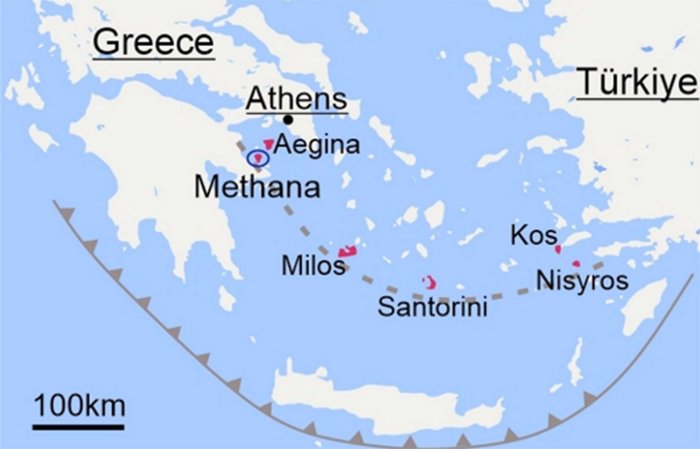
This map shows the South Aegean volcanic arc and the location of the most important volcanic areas. (Graphic: Popa et al., 2026, Science Advances)
Based on certain minerals found in ejected magmatic rock, ETH researchers have now demonstrated that a great deal of magma nevertheless accumulated underground during this period.
This makes it clear that inactive volcanoes, especially those along subduction zones, need to be better monitored and that their hazard potential should be reassessed.
No ash clouds, no lava, no explosive eruptions: For more than 100,000 years, the Greek volcano Methana was almost completely dormant. It was considered extinct – like many other volcanoes.
Led by Olivier Bachmann, Professor of Volcanology and Magmatic Petrology at ETH Zurich, an international research team has meticulously reconstructed the history of the volcano – and made a startling discovery: While Methana exhibited very little volcanic activity on its surface, large quantities of magma steadily accumulated deep within its magma chambers.
Crystals reveal the history of eruptions
To unlock this secret of the volcano, researchers examined tiny minerals called zircons. These small crystals form when magma cools inside reservoirs in the Earth’s crust. They function like natural time capsules: zircons record when and under what conditions they grew.
The researchers analyzed more than 1,250 such crystals, covering a period of 700,000 years of volcanic history. This allowed them to reconstruct the volcano’s internal structure very accurately.
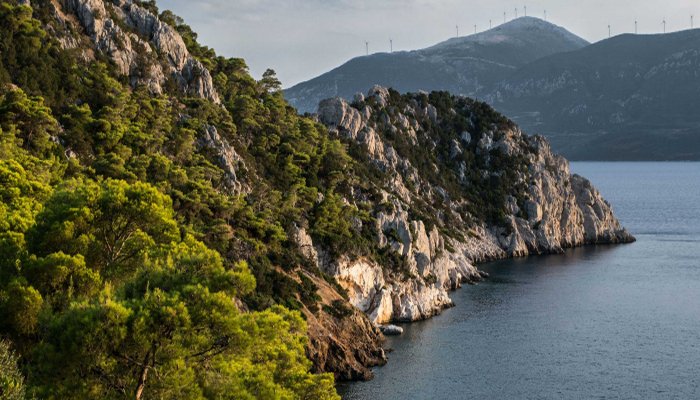
The most recent lava (brown rocks, center of image) erupted by the Methana volcano flowed into the sea. The light-colored rocks in the background are limestone, which is geologically much older than the lava. Image credit: Răzvan-Gabriel Popa / ETH Zurich
The results clearly show that magma was formed almost continuously deep underground in Methana. While there were periods of eruptions, there was also a particularly long pause of over 100,000 years during which there was very little volcanic activity at the surface.
It was precisely during this phase that most zircons grew. “This is a clear indication that the magma was very active underground – just without reaching the surface,” explains the study’s first author, Razvan-Gabriel Popa, who works in Bachmann’s group.
Why did the magma get stuck in Methana?
The researchers explain the volcano’s behavior primarily by the water content of the magma. The molten rock that supplied the magma chamber in the upper crust contained a very high amount of water, making it significantly richer than the researchers had expected. Such “superhydrated” magmas contain more than six percent water by weight.
The excess water changes everything: As this magma rises through the crust, it becomes saturated with water and forms bubbles. In turn, the water saturation triggers the crystallization of the magma. This reduces its mobility.
Such magma effectively slows itself down as it rises, as researchers have demonstrated using physical and thermodynamic models. It becomes increasingly slower and eventually gets trapped in the Earth’s crust. The result: no eruption, but a growing magma reservoir several kilometers below the surface.
Earth’s mantle moistens magma production
But where does this extremely water-rich magma come from? The answer lies in the Earth’s mantle. Beneath Methana, the mantle is strongly influenced by materials that descend with a subducting tectonic plate, including seafloor sediments and large quantities of water. This process “moistens” the Earth’s mantle and makes magma production particularly efficient.
Paradoxically, more magma coming from the depths can lead to fewer eruptions because the magma has too much water and is too crystalline to reach the surface.
The Greek volcano is not an isolated case. Researchers suspect that many volcanoes in subduction zones – where oceanic plates dive beneath continents – are periodically fed by particularly water-rich and primitive magma.
“These superhydrated rock melts could be prevalent in volcanoes located near subduction zones,” said Popa. “Methana is a good example of where we were able to clearly observe this effect. However, the implications of our findings can be generalized and are far-reaching.”
Tens of thousands of years of peace do not mean the all-clear.
The study’s most important message is clear – and alarming: A long period of volcanic dormancy does not mean that a volcano is extinct forever. On the contrary, it can even indicate that a larger and potentially more dangerous magma system is building up underground.
This is particularly relevant for assessing the risk: volcanoes that haven’t erupted for tens of thousands of years are often considered extinct and are rarely monitored. But Methana shows how risky this assumption can be: such volcanoes can lie dormant for millennia while building up immense internal pressure for a future reawakening.
Lessons for other volcanoes
“For the authorities responsible for volcanic risks, this means they must reassess the hazard level of volcanoes that have been dormant for millennia but regularly show signs of magmatic activity,” says Bachmann.
Modern monitoring methods – such as those for detecting earthquakes, ground deformations or escaping gases, but also the mapping and investigation of the subsurface using high-resolution geophysical methods – can help to detect such hidden processes early on.
Written by Eddie Gonzales Jr. – MessageToEagle.com Staff Writer

