
Miranda: Probably The Strangest Of Uranus’ Moons
A. Sutherland – MessageToEagle.com – Five large moons and at least 22 small moons orbit Uranus, but probably the strangest of them is Miranda.
It is a small moon but its surface is really amazing. Miranda, which reveals a complex geologic history, is one of the strangest phenomena in our solar system.
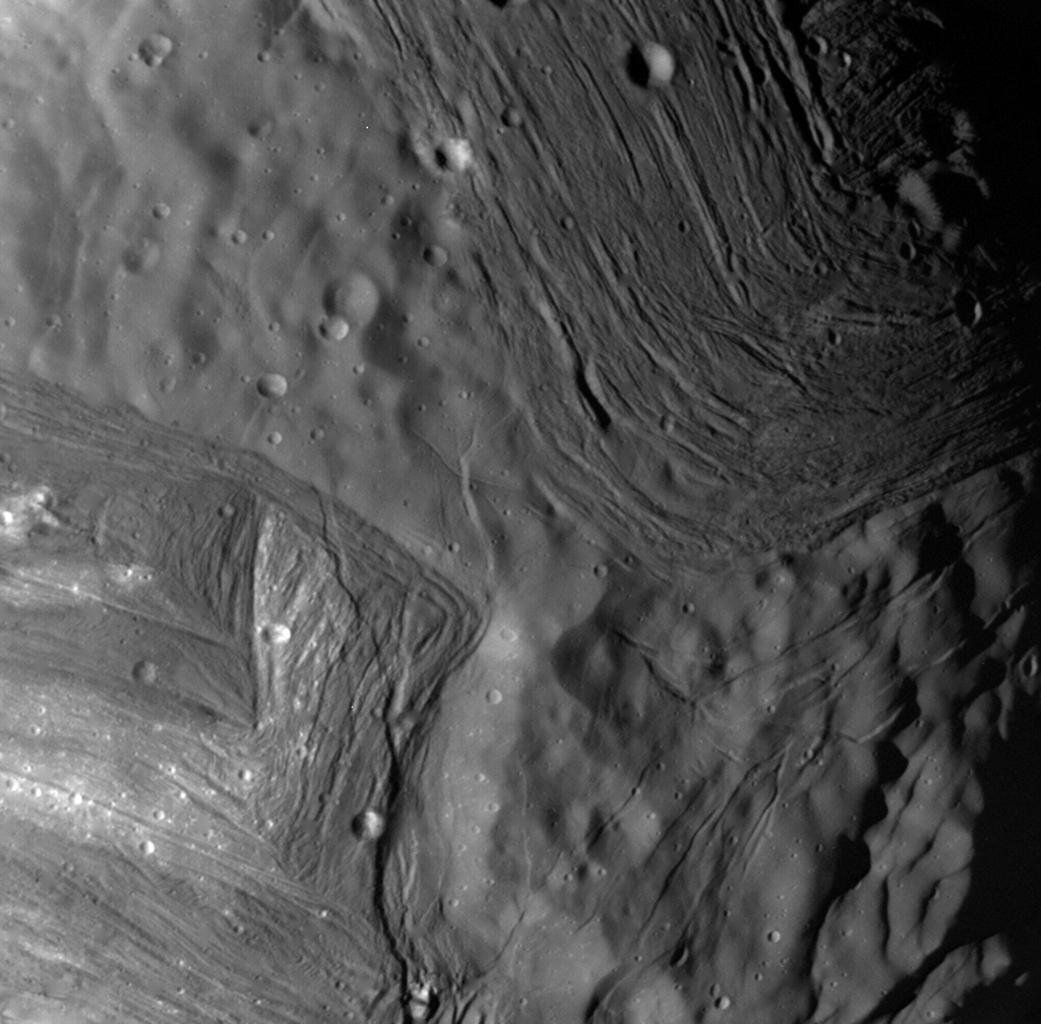
It has a distinctly differing terrain that looks almost like a patchwork of different landscapes.
In one place, Miranda can surprise us with a region full of craters (many 5 km (3 mi) wide), and suddenly, next to it, Miranda’s terrain changes and exhibits lots of massive mountain ridges.
There are also other surface features such as huge fault canyons as deep as 20 km (12 miles), terraced layers, an unusual ‘chevron’ figure and rolling plains.
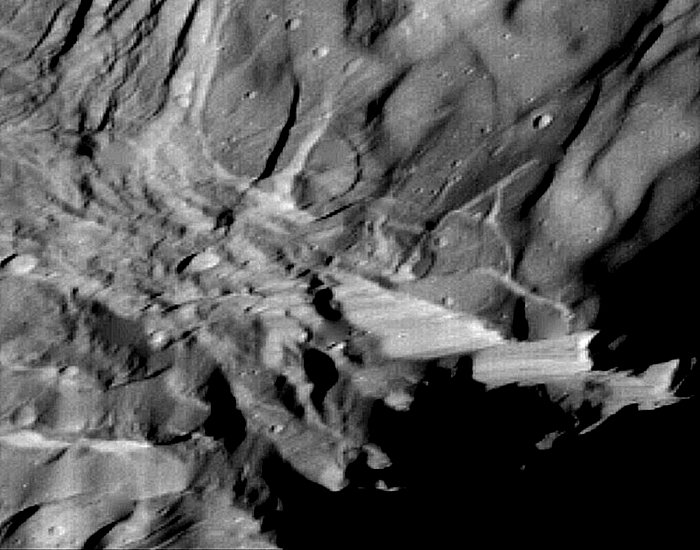
But perhaps one of the most bizarre features of Miranda that clearly demonstrates its dramatic past is Verona Rupes – a bizarre cliff that it has been estimated to be from 5 to 10 kilometers (3 to 6 mi) high, which makes it the tallest known cliff in the Solar System.
What did form Miranda’s dramatic surface?
It has been suggested that this mixture of different terrain types on older and younger surfaces was caused by a large diversity of tectonic activity. Violent impacts battered Miranda’s surface in the past, and tidal heating caused by Uranus’s gravitational pull.
See also:
Doomed Moons Of Uranus – Cupid And Belinda Are On Collision Course
Winds On Uranus And Neptune Can Reach Supersonic Speeds
Unique Extraterrestrial Aurora Photographed Another Wonder Of Our Solar System
Miranda – the smallest and innermost of Uranus’s five round satellites – was discovered as the last, in 1948 before Voyager 2 made its Uranus flyby and observed Miranda, which located closest to the planet.
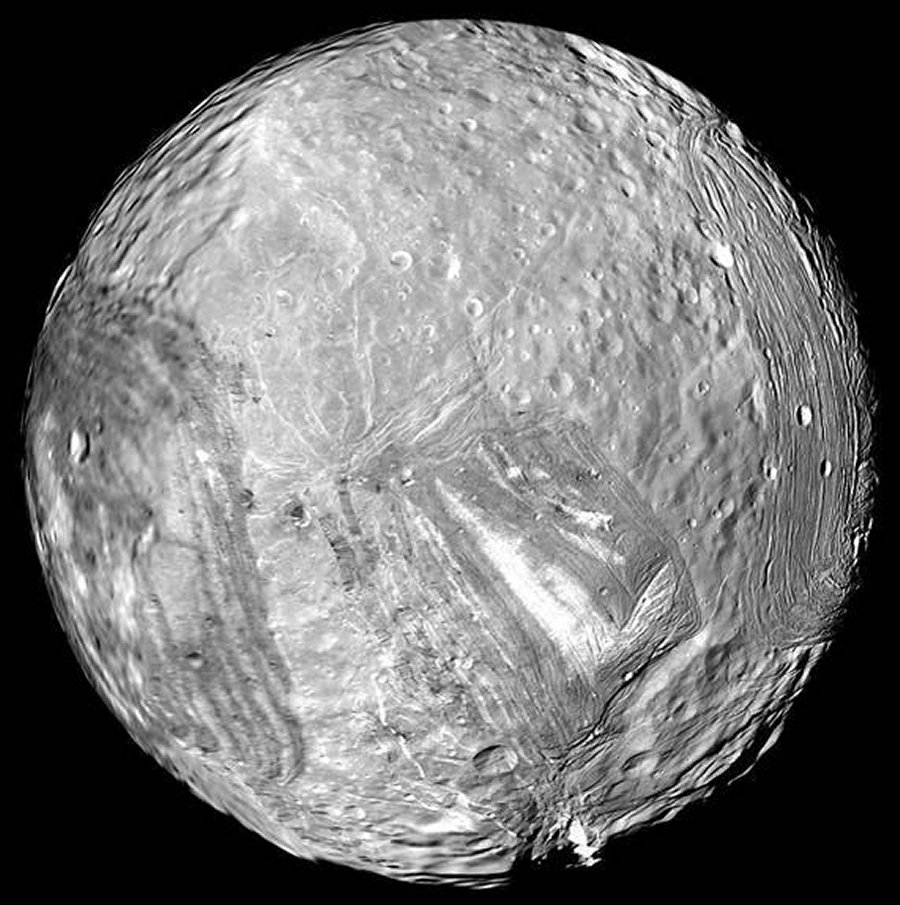
Until now, there is no sure explanation as to why Miranda’s surface looks like it does. One theory suggests that this moon must have been destroyed and then built up again thanks to gravity. But there is also another plausible theory, which suggests that a small Uranus’ moon, Ariel, and Miranda were once in “conflict” with each other, which made them both to be heated. When Miranda was heated up, some areas sank together and that is what we see today on its surface.
Some astronomers argued that Miranda was once crushed by collision with an asteroid but it managed to pull itself together again into a single body.
There is also another possibility that this moon froze when it was in a stage of its forming when rock masses were still sinking to Miranda’s interior and lighter chunks of ice were rising to the surface.
Written by A. Sutherland – MessageToEagle.com Senior Staff Writer
Copyright © MessageToEagle.com All rights reserved. This material may not be published, broadcast, rewritten or redistributed in whole or part without the express written permission of MessageToEagle.com
Expand for referencesRelated Posts
-
 Our Neighbor Alpha Centauri: Search For Habitable Planets In The System, Continues
-
 NASA’s Fermi Detects First Gamma-Ray Eclipses From ‘Spider’ Star Systems
-
 Solar Weather Has Real Material Effects On Earth
-
 Supermassive Black Holes Inside Dying Galaxies Detected In Early Universe
-
 Explosive Neutron Star Merger Captured For The First Time In Millimeter Light
-
 Monster Galaxy XMM-2599 Formed Stars At A High Rate And Then Died
-
 Cosmic Mystery – What Happened To Earth’s Second Moon?
-
 Beyond The Shadow Of A Black Hole
-
 Unique Planet Orbiting Three Suns Discovered In The Orion Constellation
-
 First Confirmed Direct Image Of A Brown Dwarf Orbiting A Star In The Hyades Cluster

