
Most Distant Periphery Of The Milky Way – Identified
Eddie Gonzales Jr. – MessageToEagle.com – The utmost edge of the Milky Way galaxy has been identified by researchers using the Subaru Telescope’s Hyper Suprime-Cam (HSC) digital camera .
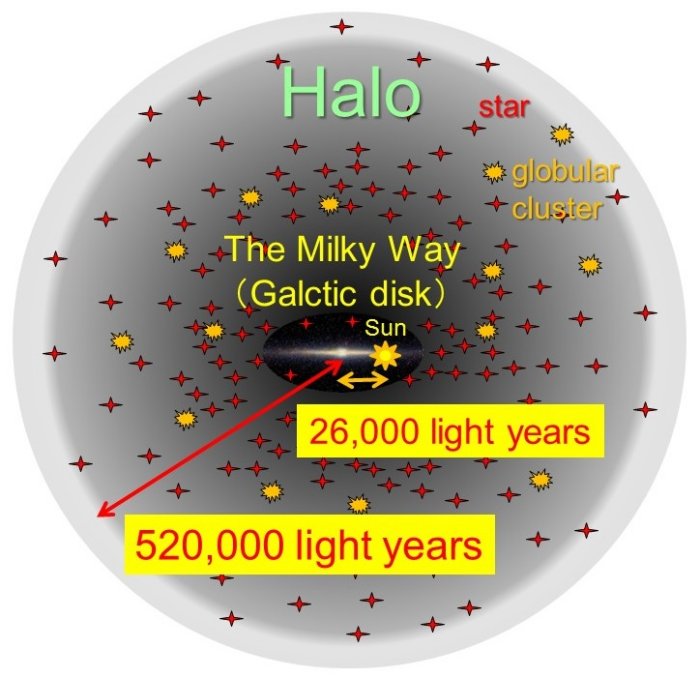
The ultimate size of the galaxy is 520,000 light years in radius, 20 times larger than the distance between the galactic center and our solar system (26,000 light years) (Figure 1).
Stars that reach these outermost regions of the galaxy during their orbital motions are ancient stellar populations with ages as old as 12 billion years.
The spatial extent in which these ancient stars wander is, therefore, important for understanding the Milky Way’s formation.
The galaxy holds a widely extended halo component, in addition to the bright Milky Way in the form of the stellar disk component.
The halo comprises approx. 1 billion ancient stars and 150 globular clusters with ages as old as 12 billion years (Figure 1). The halo thus contains the remnants of long-lived stars and star clusters that formed in the first stage of the galaxy.
This suggests that the galaxy was quite large in its beginning before the later formation of the younger, disk component.
Investigating the expanse of this halo component in the galaxy is comparable to identifying the outer boundary of a forest from inside the forest and observing the trees.
The team of researchers led by Tohoku University graduate student Tetsuya Fukushima and his supervisor Masashi Chiba derived the spatial density of the so-called Blue Horizontal Branch (BHB) stars over the galaxy halo.
While this density generally decreases the further you go from the galactic center, the team discovered a sharp drop in density at around 520,000 light years away from the galactic center.
As a result, the team had finally observed the outermost edge of the galaxy. This is about 20 times larger than the distance between our solar system and the galaxy center.
Our neighbor, the Andromeda galaxy, is reported to have an extended halo component as large as 538,000 (at the very least) light years in radius. It is, therefore, systematically larger when compared to the galaxy halo.
Further mapping of this ancient component of the galaxyis planned.
Written by Eddie Gonzales Jr. – MessageToEagle.com Staff
Related Posts
-
 Unique Extraterrestrial Aurora Photographed Another Wonder Of Our Solar System
-
 Monster Galaxy XMM-2599 Formed Stars At A High Rate And Then Died
-
 Galactic Explosion: New Insight Into The Cosmos With JWST
-
 Alien World K2-18b In Constellation Leo Is Solid Like Earth But Several Times Larger
-
 Astronomy Student Discovers 17 New Planets Including Earth-Sized World
-
 How Solar Flares Affect Human Health – Our Mind And Body
-
 Looking Deeper Into Violent Neutron Star Collisions
-
 Sunlight Filtering Through Venus’ Clouds Could Support Earth-Like Photosynthesis In The Cloud Layers
-
 One Of The Fastest-Spinning Stars In The Universe – Discovered
-
 Can Life On A Planet Survive The Death Of Its Star?

