
New Approach May Shed New Light On Dark Energy Conundrum
Eddie Gonzales Jr. – MessageToEagle.com – Much mystery surrounds dark energy and the cosmological constant, the proxies used to explain the accelerating expansion of the Universe.
New research by a team of Columbian scientists proposes a novel approach to solving this cosmic conundrum.
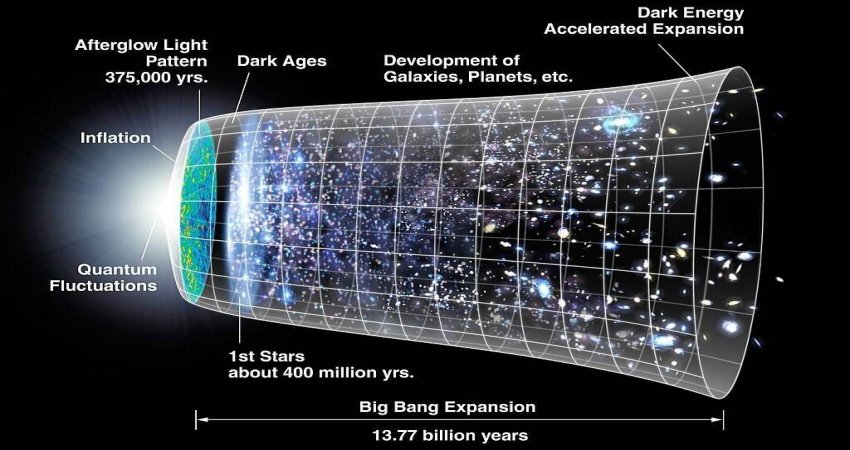 A diagram of the expansion of the Universe. This accelerating expansion of the Universe could be explained by an early dark energy model. (NASA/ WMAP Team). Credit: NASA
“Our work is a proposal for a candidate dark energy model, as an alternative to the standard cosmological constant,” Luz Ángela García, an astronomer at Universidad ECCI, Colombia, the corresponding author of the study, said.
“This theoretical model provides a possible explanation for the current accelerated expansion of the Universe.”
The Universe is not only expanding but doing so at an accelerating rate. Yet, despite the fact that astronomers, cosmologists, and physicists have been aware of this for two decades, the force driving this expansion is still an unknown.
A placeholder or proxy for this force, dark energy—a smooth fluid-like component that fills the Universe with a negative pressure—has been inserted into standard cosmological models with the cosmological constant (represented by the symbol lambda) used to define that acceleration.
But still, the true nature of this important element of the Universe is a mystery.
“The cosmological constant has serious theoretical issues. Plenty of alternative models have been proposed, but some of them need to be very mathematically complex in order to provide a physical interpretation of the phenomena,” says García.
“We present a completely different form of dark energy that by construction produces the accelerated expansion in this stage of the Universe, but also evolves with redshift; therefore, it can be linked to other astronomical observations in the past.”
The Universe is not only expanding but doing so at an accelerating rate. Yet, despite the fact that astronomers, cosmologists and physicists have been aware of this for two decades, the force driving this expansion is still an unknown. A placeholder or proxy for this force, dark energy—a smooth fluid-like component that fills the Universe with a negative pressure—has been inserted into standard cosmological models with the cosmological constant (represented by the symbol lambda) used to define that acceleration.
But still, the true nature of this important element of the Universe evades us.
The research, published in New Astronomy, was conducted by Luz Ángela García, an astronomer at Universidad ECCI, Colombia, and her co-authors, Leonardo Castañeda and Juan Manuel Tejeiro from Observatorio Astronómico Nacional, Universidad Nacional de Colombia, Colombia.
via Physorg
Written by Eddie Gonzales Jr. – MessageToEagle.com Staff
Related Posts
-
 Planets In L 98-59 Exoplanet System Resemble Those In The Inner Solar System
-
 Different Bright Areas On Ceres Suggest Geologic Activity
-
 Carbon Dioxide Cold Traps On The Moon – Confirmed For The First Time
-
 First Evidence Of Water Vapor On Jupiter’s Moon Ganymede Discovered By Hubble
-
 Detection Of The Nanohertz Gravitational-Wave Background – New Step Taken By Researchers
-
 A Diamond Bigger Than Earth Is Located In The Constellation Of Cancer
-
 10 Astronomy Facts: Remarkable, Fascinating And Puzzling
-
 First Radio Detection Of Rare Supernova Type – Secrets of Stellar Death Revealed
-
 Giant Mystery Wave Spotted In Atmosphere Of Venus
-
 ALMA Helps To Discover Trio Of Young Exoplanets In Constellation Of Sagittarius

