
New Window Insulation Blocks Heat, But Not Your View – CU Boulder’s Physicists New Design
Eddie Gonzales Jr. – MessageToEagle.com – Physicists at CU Boulder have designed a new material for insulating windows that could improve the energy efficiency of buildings worldwide—and it works a bit like a high-tech version of Bubble Wrap.
The team’s material, called Mesoporous Optically Clear Heat Insulator (MOCHI), is available in large slabs or thin sheets that can be applied to the interior of any window.
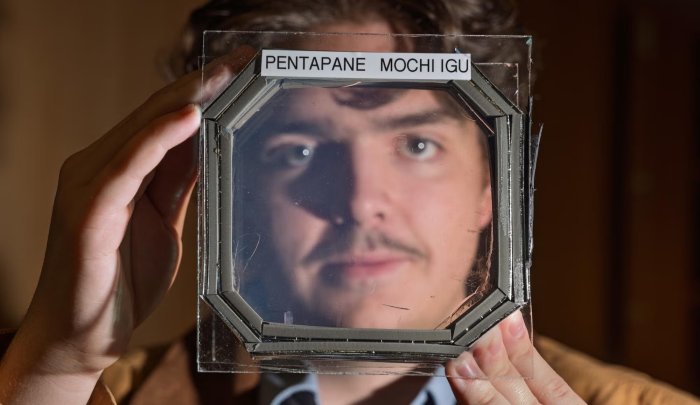
Abram Fluckiger, an undergraduate student at CU Boulder, holds up a block containing five layers of MOCHI material and two panes of glass. Image credit: Glenn Asakawa/CU Boulder
So far, the team only makes the material in the lab, and it’s not available for consumers. But the researchers say MOCHI is long-lasting and is almost completely transparent.
That means it won’t disrupt your view, unlike many insulating materials on the market today,
“To block heat exchange, you can put a lot of insulation in your walls, but windows need to be transparent,” said Ivan Smalyukh, senior author of the study and a professor of physics at CU Boulder. “Finding insulators that are transparent is really challenging.”
He and his colleagues published their results Dec. 11 in the journal “Science.”
Buildings, from single-family homes to office skyscrapers, consume about 40% of all energy generated worldwide. They also leak, losing heat to the outdoors on cold days and absorbing heat when the temperature rises.

Eldho Abraham, left, and Taewoo Lee, right, hold up a new window insulation material called MOCHI affixed to a thin sheet of plastic, which was designed by CU Boulder researchers in physic professor Ivan Smalyukh’s lab. Credit: Glenn J. Asakawa / CU Boulder
Smalyukh and his colleagues aim to slow down that exchange.
The group’s MOCHI material is a silicone gel with a twist: The gel traps air through a network of tiny pores that are many times thinner than the width of a human hair. Those tiny air bubbles are so good at blocking heat that you can use a MOCHI sheet just 5 millimeters thick to hold a flame in the palm of your hand.
“No matter what the temperatures are outside, we want people to be able to have comfortable temperatures inside without having to waste energy,” said Smalyukh, a fellow at the Renewable And Sustainable Energy Institute (RASEI) at CU Boulder.
Bubble magic
Smalyukh said the secret to MOCHI comes down to precisely controlling those pockets of air.
The team’s new invention is similar to aerogels, a class of insulating material that is in widespread use today. (NASA uses aerogels inside its Mars rovers to keep electronics warm).
Like MOCHI, aerogels trap countless pockets of air. But those bubbles tend to be distributed randomly throughout aerogels and often reflect light rather than let it pass through. As a result, these materials often look cloudy, which is why they’re sometimes called “frozen smoke.”
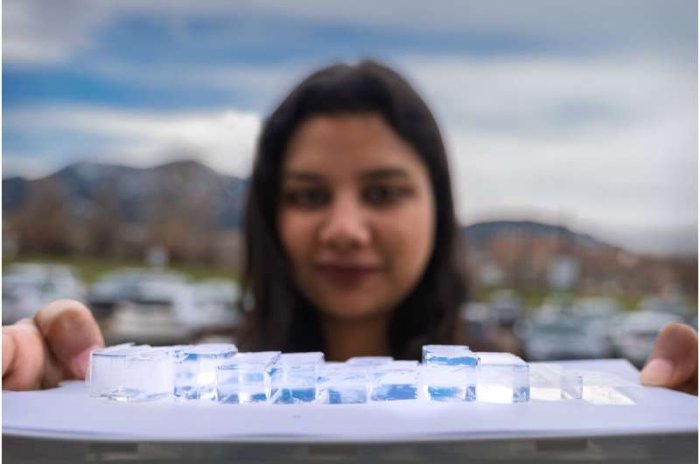
Shakshi Bhardwaj holds up blocks in different sizes of a new material nearly transparent insulation material called MOCHI, which was designed buy CU Boulder researchers in physics professor Ivan Smalyukh’s lab. Credit: Glenn J. Asakawa / CU Boulder
In the new research, Smalyukh and his colleagues wanted to take a different approach to insulation.
To make MOCHI, the group mixes a special type of molecule known as surfactants into a liquid solution. These molecules naturally clump together to form thin threads in a process not unlike how oil and vinegar separate in salad dressing. Next, molecules of silicone in the same solution begin to stick to the outside of those threads.
Through a series of steps, the researchers then replace the clumps of detergent molecules with air. That leaves silicone surrounding a network of incredibly small pipes filled with air, which Smalyukh compares to a “plumber’s nightmare.”
In all, air makes up more than 90% of the volume of the MOCHI material.
Trapping heat
Smalyukh said that heat passes through a gas in a process something like a game of pool: Heat energizes molecules and atoms in the gas, which then bang into other molecules and atoms, transferring the energy.
The bubbles in MOCHI material are so small, however, that the gases inside can’t bang into each other, effectively keeping heat from flowing through.
“The molecules don’t have a chance to collide freely with each other and exchange energy,” Smalyukh said. “Instead, they bump into the walls of the pores.”
At the same time, the MOCHI material only reflects about 0.2% of incoming light.
The researchers see a lot of uses for this clear-but-insulating material. Engineers could design a device that uses MOCHI to trap the heat from sunlight, converting it into cheap and sustainable energy.
“Even when it’s a somewhat cloudy day, you could still harness a lot of energy and then use it to heat your water and your building interior,” Smalyukh said.
You probably won’t see these products on the market soon. Currently, the team relies on a time-intensive process to produce MOCHI in the lab. But Smalyukh believes the manufacturing process can be streamlined. The ingredients his team uses to make MOCHI are also relatively inexpensive, which the physicist said bodes well for turning this material into a commercial product.
For now, the future for MOCHI, like the view through a window coated in this insulating material, looks bright.
Written by Eddie Gonzales Jr. – MessageToEagle.com Staff Writer
Related Posts
-
 Entirely Renewable Clean Energy From Which Water Would Be The Only Waste Product Is Becoming Reality
-
 A New Information Storage And Processing Device – Quantum Physics And Artificial Intelligence Breakthrough
-
 Mysterious Technology Interferences At Earth’s Poles Investigated
-
 Converting Body Heat Into Electricity: A Step Closer Towards High-Performance Organic Thermoelectrics
-
 “Lab On Skin”: Smart Bandage Monitors The Status Of Chronic Wounds, Delivers Treatment, Speeds Up The Healing Process
-
 Eternal 5D Data Storage: Securing The Last Evidence Of Our Civilization
-
 Engineers Created A Robot That Can Jump 10 Feet High – Without Legs
-
 Development Of A Diamond Transistor With High Hole Mobility
-
 New Shape-Shifting Material Can Bend, Twist, And Lift Objects 1,000 Times Its Own Weight
-
 Food Waste And New Method For Making Biodiesel Fuel

