
Our Universe Is Expanding Faster Than Expected – New Study Suggests
MessageToEagle.com – A new study conducted by astronomers using Hubble Space telescope reveals our universe is expanding 5 percent to 9 percent faster than expected.
“This surprising finding may be an important clue to understanding those mysterious parts of the universe that make up 95 percent of everything and don’t emit light, such as dark energy, dark matter, and dark radiation,” said study leader and Nobel Laureate Adam Riess of the Space Telescope Science Institute and The Johns Hopkins University, both in Baltimore, Maryland.
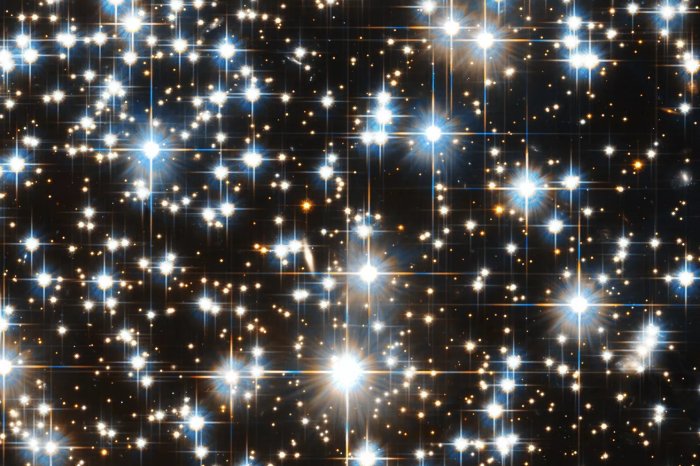
There are a few possible explanations for the universe’s excessive speed. One possibility is that dark energy, already known to be accelerating the universe, may be shoving galaxies away from each other with even greater—or growing—strength.
Another idea is that the cosmos contained a new subatomic particle in its early history that traveled close to the speed of light. Such speedy particles are collectively referred to as “dark radiation” and include previously known particles like neutrinos. More energy from additional dark radiation could be throwing off the best efforts to predict today’s expansion rate from its post-big bang trajectory.
The boost in acceleration could also mean that dark matter possesses some weird, unexpected characteristics. Dark matter is the backbone of the universe upon which galaxies built themselves up into the large-scale structures seen today.
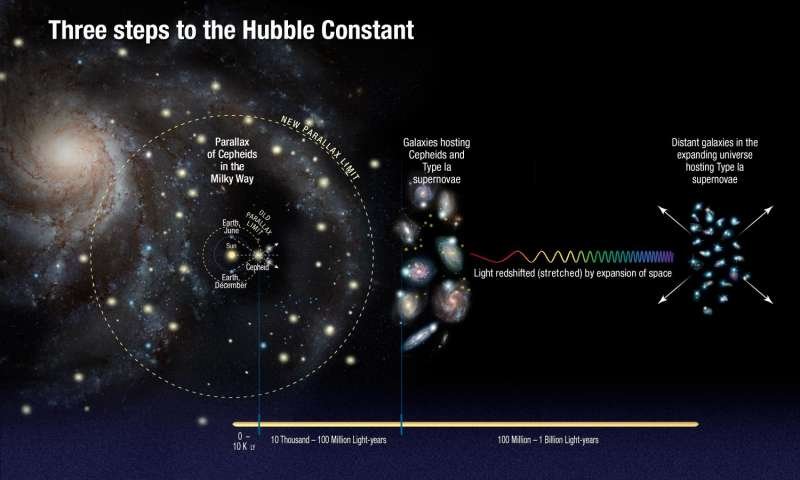
Riess’ team looked for galaxies containing both Cepheid stars and Type Ia supernovae. Cepheid stars pulsate at rates that correspond to their true brightness, which can be compared with their apparent brightness as seen from Earth to accurately determine their distance. Type Ia supernovae, another commonly used cosmic yardstick, are exploding stars that flare with the same brightness and are brilliant enough to be seen from relatively longer distances.
By measuring about 2,400 Cepheid stars in 19 galaxies and comparing the observed brightness of both types of stars, they accurately measured their true brightness and calculated distances to roughly 300 Type Ia supernovae in far-flung galaxies.
The team compared those distances with the expansion of space as measured by the stretching of light from receding galaxies.
See also:
Mysterious Force Responsible For Accelerating Expansion Of The Universe
Why Huge Numbers Of Galaxies Turn Into Cosmic Graveyards?
Pluto’s Moon Hydra Is Covered In Almost Pure Water Ice – New Data Confirms Earlier Hints
“If we know the initial amounts of stuff in the universe, such as dark energy and dark matter, and we have the physics correct, then you can go from a measurement at the time shortly after the big bang and use that understanding to predict how fast the universe should be expanding today,” said Riess. “However, if this discrepancy holds up, it appears we may not have the right understanding, and it changes how big the Hubble constant should be today.”
Comparing the universe’s expansion rate with WMAP, Planck, and Hubble is like building a bridge, Riess explained. On the distant shore are the cosmic microwave background observations of the early universe. On the nearby shore are the measurements made by Riess’ team using Hubble.
“You start at two ends, and you expect to meet in the middle if all of your drawings are right and your measurements are right,” Riess said. “But now the ends are not quite meeting in the middle and we want to know why.”
The research will be published in an upcoming edition of the Astrophysical Journal.
MessageToEagle.com
Related Posts
-
 ALMA Maps Icy Moon Europa’s Temperature
-
 Mysterious Interstellar Object Oumuamua Is Not What We Expected – New Theory Suggests
-
 The Very First Microscopic Clusters From Big Bang – Reconstructed
-
 Fossilized Bulge Records Moon’s Slow Retreat From Our Planet
-
 Bizarre White Dwarf Star Blasted Itself Out Of Its Orbit And Travels Across Milky Way
-
 Black Hole Eruption Spanning 16 Times The Full Moon In The Sky – Captured
-
 Earth’s Magnetic Shield Vibrates Like A Drum When Hit By Impulses
-
 Moon Emerged From A Giant Donut-Shaped Cloud Of Vaporized Rock – New Theory
-
 MUSE Instrument Discovers 72 New Unseen Galaxies In Constellation Of Fornax (The Furnace)
-
 Strange Giant Planet Orbiting At A Large Distance Around A Sun-Like Star Puzzles Astronomers

