
Precious Metals May Be Locked Deep Below The Moon’s Surface – New Study
Eddie Gonzales Jr. – MessageToEagle.com – A repository of precious metals may be locked deep below the moon’s surface, researchers say, who were able to draw parallels between mineral deposits found on Earth and the moon.
“We have been able to link the sulfur content of lunar volcanic rocks to the presence of iron sulfide deep inside the moon,” James Brenan, a professor at the Department of Earth and Environmental Sciences at Dalhousie and lead author of the study, Dr. Brenan, said in a press release.
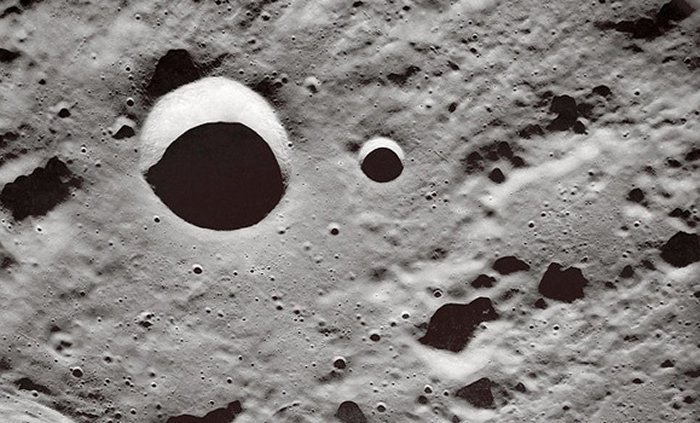 This oblique view of the moon’s surface photographed by the Apollo 10 astronauts in May 1969. Image credit: NASA
“Examination of mineral deposits on Earth suggests that iron sulfide is a great place to store precious metals, like platinum and palladium.”
Early measurements of the precious metal concentrations in lunar volcanic rocks done in 2006, however, showed unusually low levels, raising a question that has perplexed scientists for more than a decade as to why there was so little.
Dr. Brenan says it had been thought that those low levels reflected a general depletion of the precious metals in the moon as a whole.
“Our results show that sulfur in lunar volcanic rocks is a fingerprint for the presence of iron sulfide in the rocky interior of the moon, which is where we think the precious metals were left behind when the lavas were created,” he says.
Researchers measured the composition of the resulting rock and iron sulfide and confirmed that the precious metals would be bound up by the iron sulfide, making them unavailable to the magmas that flowed out onto the lunar surface.
There was likely not enough to form an ore deposit, but certainly enough to explain the low levels in the lunar lavas,” Brenan said. However, samples from the deep, rocky part of the moon where the lunar lavas originated, are necessary to confirm the recent findings.
Geologists have access to scientific samples from hundreds of kilometers deep inside the Earth, but such material has not yet been recovered from the moon.
“We have been scouring the Earth’s surface for a fairly long period of time, so we have a pretty good idea of its composition, but with the moon that’s not so at all,” he said.
“We have a grand total of 400 kilograms of the sample that was brought back by the Apollo and lunar missions… it’s a pretty small amount of material. So, in order to find out anything about the interior of the moon we have to kind of reverse engineer the composition of the lavas that come onto the surface.”
Remote sensing by satellites suggests there may be outcroppings of the deeper parts of the moon, revealed after massive impacts formed the Schrödinger and Zeeman craters in the South Pole Aitken basin.
“It’s pretty exciting to think that we might return to the moon,” says Dr. Brenan. “And if so, the South Pole seems like a good choice for sampling.”
Written by Eddie Gonzales Jr. – MessageToEagle.com Staff
Related Posts
-
 Galaxy Clusters Yield New Evidence For Cosmology’s Standard Model
-
 Orbital Harmony Limits Late Arrival Of Water On TRAPPIST-1 Planets
-
 Astronomers Pinpoint The Location Of The Brightest Fast Radio Burst To Date
-
 Bright Unknown Object Observed Near Black Hole In Cygnus A Galaxy
-
 Discovery Of Elusive Solar Waves That Could Power The Sun’s Corona
-
 Pluto’s Moon Charon Once Had A Subsurface Ocean
-
 Searching For Traces Of Dark Matter With Neutron Spin Clocks
-
 Black Hole “Unicorn” Is Closest To Earth And Smallest Ever Discovered
-
 Big Cosmological Mystery: Discovery Of Second Ultra-Large Structure In Distant Space Further Challenges Our Understanding Of The Universe
-
 Orion Spacecraft Continues Toward The Moon, Callisto Activated

