
On This Day In History: Thor Heyerdahl Sails From Morocco On Papyrus Boat Ra II To Barbados – On May 17, 1970
MessageToEagle.com – On 17th May 1970, the reed boat Ra II with Thor Heyerdahl accompanied by an international crew, set sail from Safi in Morocco on course for Barbados.

With this expedition Thor Heyerdahl (1914 – 2002) wanted to prove that one could have used this type of vessel to cross the Atlantic Ocean in ancient times.
The vessel, Ra II, was built of papyrus by Demetrio, Juan and Jose Limachi from Lake Titicacain Bolivia, and based on drawings and models from Ancient Egypt.
A year earlier, Heyerdahl built a 45-foot-long copy of an ancient Egyptian papyrus vessel with the aid of traditional boat builders from Lake Chad in Central Africa.

Named after the sun god Ra, the boat was transported to Safi in Morocco, from where it set sail for the Caribbean on May 24, 1969. Defects in design and other sailing problems caused it to founder in July, 600 miles short of its goal.
It had sailed 3,000 miles and had almost made it across the Atlantic Ocean.
This time, the expedition was successful.
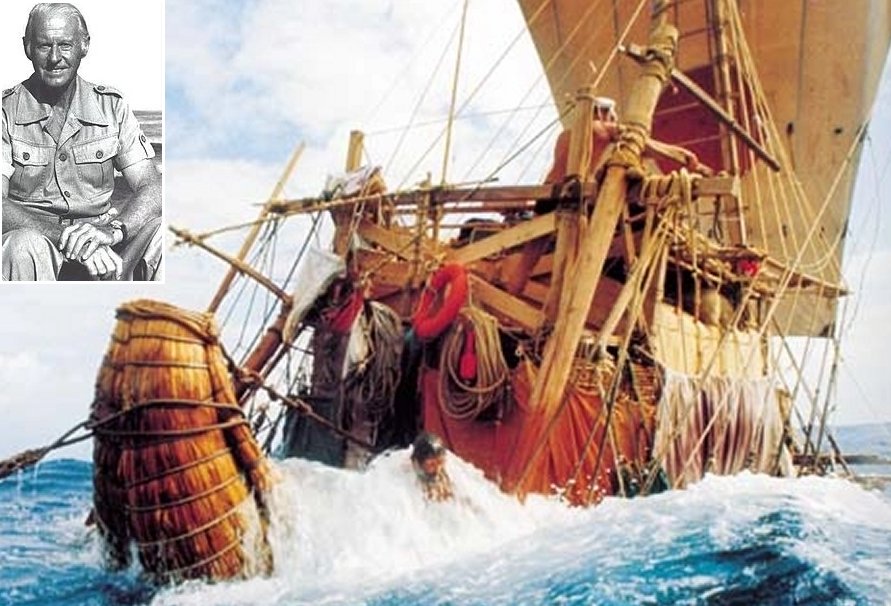
After a voyage of 57 days and 4,000 miles, the ship arrived in Barbados. The story of this voyage is recorded in the book The Ra Expeditions (1971) and in a documentary film.
Additionally, the expedition took samples of marine pollution and presented their report to the United Nations.
Thor Heyerdahl was a Norwegian adventurer and ethnographer with a background in zoology, botany, and geography. organized and led the famous Kon-Tiki (1947) and Ra (1969–70) transoceanic scientific expeditions. Both expeditions were intended to prove the possibility of ancient transoceanic contacts between distant civilizations and cultures.
For the most part, Heyerdahl’s theories have not been accepted by anthropologists.
Late in 1977 Heyerdahl and an international crew embarked upon the Tigris expedition, a four-month, 4,000-mile voyage in a craft made of reeds.
The expedition began on the Tigris River in Iraq, traveling down the Persian Gulf, across the Arabian Sea to Pakistan, and ending in the Red Sea. The goal of the Tigris expedition was to establish the possibility that the ancient Sumerians might have used similar means to spread their culture through southwest Asia and the Arabian Peninsula.
The voyage was recorded in Heyerdahl’s book The Tigris Expedition (1979) and in a documentary film. He subsequently led research expeditions to the Maldive Islands, to Easter Island, and to an archaeological site in Peru.
The Ra II is now in the Kon-Tiki Museum in Oslo, Norway.
MessageToEagle.com
Related Posts
-
 On This Day In History: Maltese Rebellion Took Place – On Sep 8, 1775
-
 On This Day In History: King Tut’s Tomb Is Unsealed And Opened – On Feb 16,1923
-
 On This Day In History: Samuel Morey Patents The Internal Combustion Engine – On April 1, 1826
-
 On This Day In History: Vlad II Known As Vlad Dracul (‘Vlad The Dragon’) Was Born – On August 30, 1400
-
 On This Day In History: Battle of Tsushima Was Fought- On May 27, 1905
-
 On This Day In History: Island Of St. Helena – Last Residence Of Napoleon Discovered – On May 21, 1502
-
 On This Day In History: Magna Carta Sealed By King John Of England – On June 15, 1215
-
 On This Day In History: King Louis XVI Of France Was Formally Arrested And Declared An Enemy Of The People – On August 13, 1792
-
 On This Day In History: Famous American Author Edgar Allan Poe Found Dying – On Oct 3, 1849
-
 On This Day In History: King Louis XVI Of France Was Put On Trial For Treason – On Dec 11, 1792

