
Unusual Behavior Of Quantum ‘Strange Metals ‘ Finally Explained
Eddie Gonzales Jr. – MessageToEagle.com – A new study led by the Flatiron Institute’s Aavishkar Patel has identified a mechanism that explains the unusual behavior of strange metals, considered one of the greatest open challenges in condensed matter physics.

A new theory explains the unusual behavior of strange metals, considered one of the greatest open challenges in condensed matter physics. The theory is based on two properties of strange metals. First, their electrons can become quantum mechanically entangled with one another, binding their fates, and they remain entangled even when distantly separated. Second, strange metals have a nonuniform arrangement of atoms. Credit: Lucy Reading-Ikkanda/Simons Foundation
For nearly 40 years, materials called ‘strange metals’ have flummoxed quantum physicists, defying explanation by operating outside the normal rules of electricity.
Now research led by Aavishkar Patel of the Flatiron Institute’s Center for Computational Quantum Physics (CCQ) in New York City has identified, at long last, a mechanism that explains the characteristic properties of strange metals.
In the August 18 issue of Science, Patel and his colleagues present their universal theory of why strange metals are so weird — a solution to one of the greatest unsolved problems in condensed matter physics. Strange metal behavior is found in many quantum materials, including some that, with small changes, can become superconductors (materials in which electrons flow with zero resistance at low enough temperatures). That relationship suggests that understanding strange metals could help researchers identify new kinds of superconductivity.
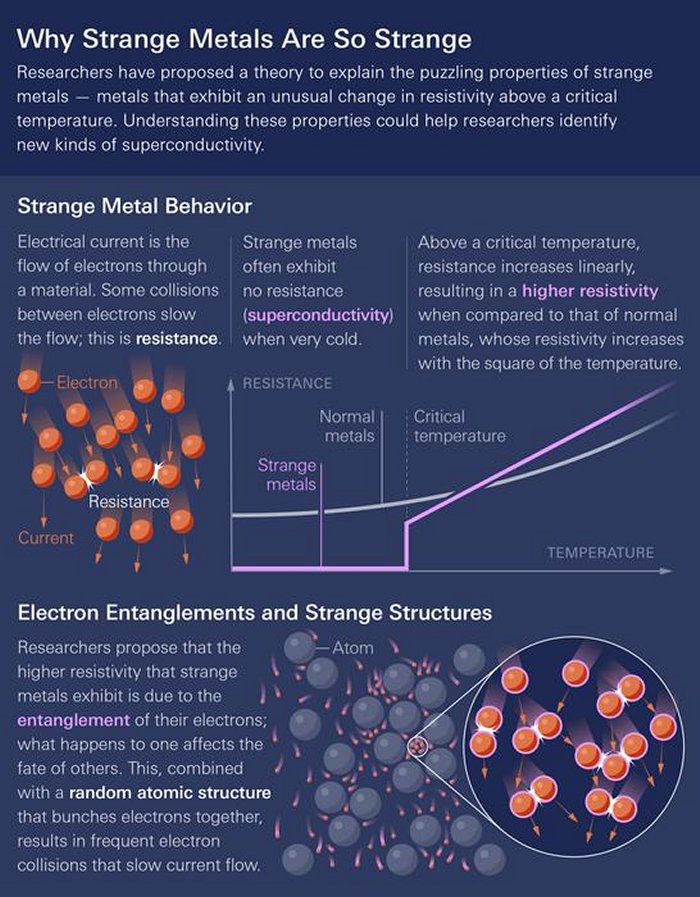
An infographic explaining a new theory that explains the odd properties of quantum materials known as strange metals. Image credit: Lucy Reading-Ikkanda/Simons Foundation
The surprisingly simple new theory explains many oddities about strange metals, such as why the change in electrical resistivity — a measure of how easily electrons can flow through the material as electrical current — is directly proportional to the temperature, even down to extremely low temperatures. That relationship means that a strange metal resists the flow of electrons more than an ordinary metal such as gold or copper at the same temperature.
The new theory is based on a combination of two properties of strange metals. First, their electrons can become quantum mechanically entangled with one another, binding their fates, and they remain entangled even when distantly separated. Second, strange metals have a nonuniform, patchwork-like arrangement of atoms.
Neither property alone explains the oddities of strange metals, but taken together, “everything just falls into place,” says Patel, who works as a Flatiron Research Fellow at the CCQ. The irregularity of a strange metal’s atomic layout means that the electron entanglements vary depending on where in the material the entanglement took place. That variety adds randomness to the momentum of the electrons as they move through the material and interact with each other. Instead of all flowing together, the electrons knock each other around in all directions, resulting in electrical resistance. Since the electrons collide more frequently the hotter the material gets, the electrical resistance rises alongside the temperature.
“This interplay of entanglement and nonuniformity is a new effect; it hadn’t been considered ever before for any material,” Patel says. “In retrospect, it’s an extremely simple thing. For a long time, people were making this whole story of strange metals unnecessarily complicated, and that was just not the right thing to do.”
Patel says that a better understanding of strange metals could help physicists develop and fine-tune new superconductors for applications such as quantum computers.
“There are instances where something wants to go superconducting but doesn’t quite do so, because superconductivity is blocked by another competing state,” he says. “One could ask then if the presence of these nonuniformities can destroy these other states that superconductivity competes with and leave the road open for superconductivity.”
Now that strange metals are a bit less strange, the name might seem less fitting than it once was. “I would like to call them unusual metals at this point, not strange,” Patel says.
Patel co-authored the new study with Haoyu Guo, Ilya Esterlis and Subir Sachdev of Harvard University.
via Eurekalert
Written by Eddie Gonzales Jr. – MessageToEagle.com Staff
Related Posts
-
 An Important Step Towards The quantum Internet Using Diamond Nanostructures
-
 Quantum Discovery Verifies A Decades-Old Theory On How Monopoles Decay
-
 New Possibilities In Hybrid Atomic Quantum Computers
-
 Physicists May Have Found The Missing Link For Quantum Computers
-
 A Path Toward Quantum Computing In Real-World Conditions – Is Now Opened
-
 ‘Missing Jigsaw Piece’: Engineers Make Critical Advance In Quantum Computer Design
-
 Researchers Reach Quantum Networking Milestone In Real-World Environment
-
 Three Scientists Share Nobel Prize In Physics For Work In Quantum Mechanics
-
 Quantum Systems Never Quite Forget Where They Came From
-
 This Exotic Particle Had An Out-Of-Body Experience And Scientists Took A Picture Of It

