
Why Are Green Galaxies So Rare?
A. Sutherland – MessageToEagle.com – Based on current scientific knowledge there are at least one hundred billion galaxies in the observable universe. The number could be twice as much if we could confirm the existence of more galaxies with better telescopes.
The galaxies we can observe are often blue or red, but very few are green. Why are green galaxies so rare?
Simulations have revealed that the colors of galaxies show the ages of and what those stars are made from translate into the color of light that they produce. The color is also an important sign that can help to determine how galaxies evolve.
According to astronomers, rare green galaxies are likely to be at an important stage in their evolution, when they are rapidly turning from blue. This occurs when new stars and planets are being born – to red as stars begin to burn themselves out.
Because stars form from dense gas, a powerful process is needed to rapidly destroy their gas supply and cause such dramatic changes in color.
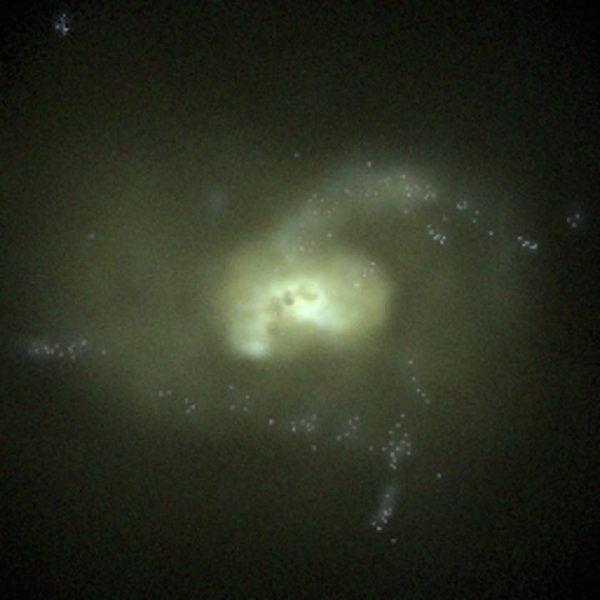
The green galaxy is caught in the act of transforming from blue to red as its gas supply runs out.
Credit: James Trayford/EAGLE/Durham University
“We typically find that smaller green galaxies are being violently tossed around by the gravitational pull of a massive neighbor, causing their gas supply to be stripped away.
“Meanwhile, bigger green galaxies may self-destruct as immense explosions triggered by super-massive black holes at their centers can blow dense gas away,” James Trayford, Ph.D. student in the ICC at Durham University, said.
See also:
Monster Black Holes 10 Billion Times Greater Than The Sun
Dung Beetles Use Stars And The Night Sky To Navigate
Earth’s Water Is Older Than The Solar System
However, there is some hope for green galaxies as a lucky few might absorb a fresh supply of gas from their surroundings.
This can revive the formation of stars and planets, and restore galaxies to a healthy blue state.
James said: “By using simulations to study how galaxy colors change, we can speed up the process of galaxy evolution from the billions of years it takes in the real Universe to just a matter of days in a computer.
“This means we don’t just see galaxy colors frozen in time, we can watch them evolve. Another advantage is that we can remove unwanted factors that may change the colors we see, such as pesky dust clouds that can prevent light escaping from galaxies.
“As the EAGLE simulations we use to represent a new level of realism, we can have greater confidence in applying these results to the real Universe.”
Written by – A. Sutherland – MessageToEagle.com Senior Staff Writer
Copyright © MessageToeagle.com All rights reserved. This material may not be published, broadcast, rewritten or redistributed in whole or part without the express written permission of MessageToeagle.com
Related Posts
-
 A Diamond Bigger Than Earth Is Located In The Constellation Of Cancer
-
 World’s Largest Underground Lake Lies Inside The Dragon’s Brеаth Cave
-
 How Is A Rainbow Formed?
-
 Time Travel And Parallel Universes: A Discussion Between A Scientist And A Literature Professor
-
 Ring Of Fire: Gigantic Zone Of Frequent Earthquakes And Volcanic Eruptions
-
 Quasars: Most Energetic, Distant And Extremely Luminous Astronomical Objects
-
 Walking Corpse Syndrome: People Who Believe They Are Dead
-
 How Dangerous Are The Biggest Solar Flares?
-
 What Does It Mean To Be Ambidextrous?
-
 The Best Source Of Human DNA

