
Will A New Type Of Extra Dark Energy Explain Expanding Universe?
Eddie Gonzales Jr. – MessageToEagle.com – The universe was created by a giant bang; the Big Bang 13.8 billion years ago, and then it started to expand. The expansion is ongoing: it is still being stretched out in all directions like a balloon being inflated.
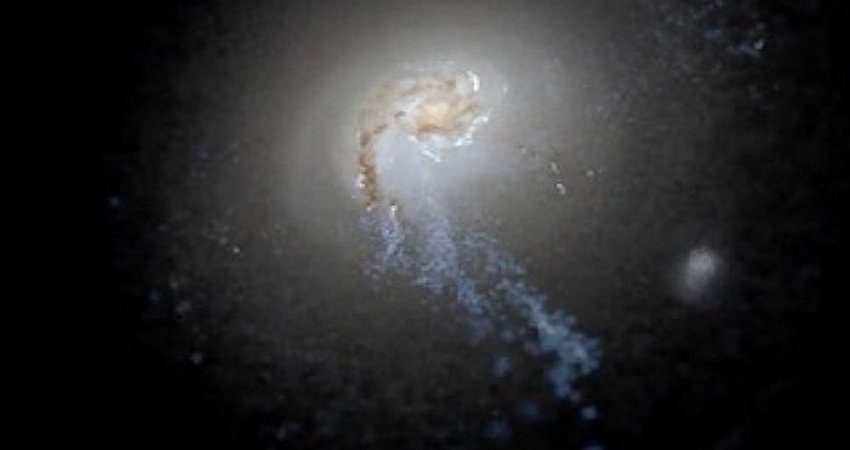
 Image credit: ESA/HUBBLE & NASA
Physicists agree on this much, but something is wrong. Measuring the expansion rate of the universe in different ways leads to different results.
So, is something wrong with the methods of measurement? Or is something going on in the universe that physicists have not yet discovered and therefore have not taken into account?
It could very well be the latter, according to several physicists, i.a. Martin S. Sloth, Professor of Cosmology at SDU.
In a new scientific article, he and his SDU colleague, postdoc Florian Niedermannn, propose the existence of a new type of dark energy in the universe. If you include it in the various calculations of the expansion of the universe, the results will be more alike.
“A new type of dark energy can solve the problem of the conflicting calculations,” says Martin S. Sloth.
When physicists calculate the expansion rate of the universe, they base the calculation on the assumption that the universe is made up of dark energy, dark matter and ordinary matter. Until recently, all types of observations fitted in with such a model of the universe’s composition of matter and energy, but this is no longer the case.
Conflicting results arise when looking at the latest data from measurements of supernovae and the cosmic microwave background radiation; the two methods quite simply lead to different results for the expansion rate.
“In our model, we find that if there was a new type of extra dark energy in the early universe, it would explain both the background radiation and the supernova measurements simultaneously and without contradiction, says Martin S. Sloth.
“We believe that in the early universe, dark energy existed in a different phase. You can compare it to when water is cooled and it undergoes a phase transition to ice with a lower density. In the same way, dark energy in our model undergoes a transition to a new phase with a lower energy density, thereby changing the effect of dark energy on the expansion of the universe.
According to Sloth and Niedermann’s calculations, the results add up if you imagine that dark energy thus underwent a phase transition triggered by the expansion of the universe.
” It is a phase transition where many bubbles of the new phase suddenly appear, and when these bubbles expand and collide, the phase transition is complete. On a cosmic scale, it is a very violent quantum mechanical process, explains Martin S. Sloth.
Today we know approx. 20 percent of the matter that the universe is made of. It is the matter that you and I, planets and galaxies are made of. The universe also consists of dark matter, which no one knows what is. In addition, there is dark energy in the universe; it is the energy that causes the universe to expand, and it makes up approx. 70 percent. of the energy density of the universe.
Written by Eddie Gonzales Jr. – MessageToEagle.com Staff
Related Posts
-
 First Glimpse Of Black Hole Eating Star, Ejecting High-Speed Flare
-
 Supernova SN 2012au Continues To Shine Today Thanks To A Powerful New Pulsar
-
 Exoplanet HD 189733b Is Facing Wind Speed Of 5,400 Miles Per Hour
-
 Astronomers Observe Young Star Forming Like A Planet
-
 NGC 2768: A Luminous Seyfert Galaxy In The Contellation Ursa Major
-
 Large Amount Of Gas Devoured By Black Holes Speeds Up Their Growth
-
 Supernova SN 2018oh Witnessed Just Minutes After Explosion Occurred 170 Million Light Years Away
-
 New Map Of Saturn’s Moon Titan Shows Features Similar To Those We Have On Earth
-
 Unique Type Ia Supernova With Hydrogen Emissions – Detected
-
 Milky Way May Be Catapulting Stars Into Its Outer Halo – New Study

