
Acacia Tree Uses Ants As Body Guards And Rewards Them With Shelter And Food
MessageToEagle.com – The relationship between the Acacia tree and ants is truly remarkable and highly beneficial to both parties.
The tree uses ants as body guards and in return, it rewards them with shelter and food.
The biological term “symbiosis” refers to what economists and politicians usually call a win-win situation. It’s a relationship between two partners which is beneficial to both, the Acacia tree and the ants. It’s an excellent example of how this practice works in nature.
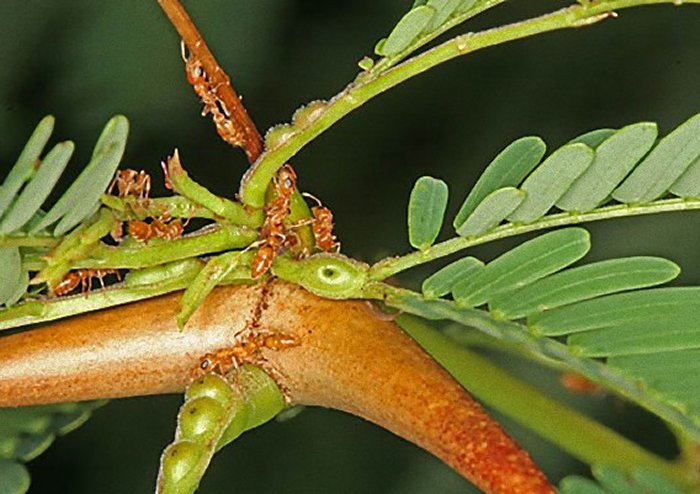
Acacia trees are part of a large genus. There are thousands of species worldwide we can find these beautiful trees in the Southern Hemisphere and in the tropical parts of the Northern Hemisphere. Acacia tree is a member of the bean family and it’s also related to locust trees and the tamarind tree. As members of the bean family, Acacias may play host to Rhizobium bacteria which infect the rpots forming characteristic root nodules
Scientists have observed symbiotic mutualistic relationship in Acacia trees growing in Central America, and Africa.
See also:
10 Fascinating Facts About Plants
The Old Man Of Crater Lake: Mysterious Tree Trunk That Defies The Laws Of Physics
Old Tjikko Is The World’s Oldest Tree
The acacia species Acacia hindsii, which is native to tropical dry forests in Central America needs protection against herbivores and competing plants. The tree offers ants of the genus Pseudomyrmex nectar and the food bodies rich in proteins and lipids which they require and in return they defend the Acacia tree.
It should be added that some of the ants are selfish and benefit from the plant’s services without giving anything in return, such as the parasitic ant species Pseudomyrmex gracilis.
Biologists have also observed the Acacia tree and the ants sometimes become enemies. This happens when the Acacia tree cuts down the sugar amount because it no longer needs as much protection as before.
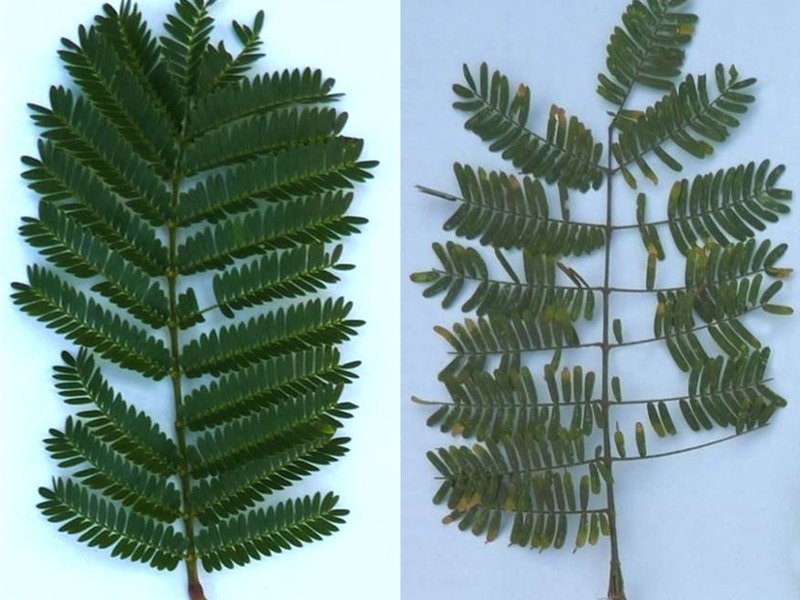
Leaves of Acacia hindsii plants colonized by mutualistic (left) or parasitic ants (right). Plants associated with the mutualistic ant species Pseudomyrmex ferrugineus are visibly healthier than their neighbours.
© MPI f. Chemical Ecology/ M. González-Teuber
If trees are fenced off to prevent large mammals from grazing on them, then there is less damage to the planets. Under these conditions, the Acacia tree cut back on the amount of sugar they provide to the ants, whose services are not as important without the herbivory occurring. Deprived of this sugar source the ants turn to another – they allow sap-sucking insects such as aphids or scale insects to attach to the plant and then get sugar exuding from the sap-suckers.
Thus, the Acacia goes from having the ants as an ally to having the ant as an enemy.
The relationship between plants, trees and animals are truly fascinated and there is still much we don’t know about our beautiful nature.
MessageToEagle.com
Expand for referencesRelated Posts
-
 The Power And Danger of Derecho
-
 118 Million-Year-Old Fossilized Dinosaur And Bird Feathers Found In Australia
-
 A Mosasaur Wakayama – ‘Blue Dragon’ Terrorized Pacific Seas 72 Million Years Ago
-
 95% Of All Modern Europeans Descended From The Seven Daughters Of Eve
-
 Biologists Find Ancient Neurohormone Controlling Appetite
-
 Very Unusual Faceless Fish Re-Discovered After Being Missing Since 1873
-
 Size Of “Small” Rosetta’s Comet Compared To Los Angeles
-
 Birds Have A ‘Sixth Sense’ And Can Feel Earth’s Magnetic Field
-
 Why Are Green Galaxies So Rare?
-
 Bayesian Yacht Tragic Accident: How Specialist Search And Rescue Teams Work Underwater

