
Keeping To Warm Climates Helped Crocodiles Outlast The Dinosaurs
Eddie Gonzales Jr. – MessageToEagle.com – Staying in warm climates throughout their 250-million-year history may have helped crocodiles and their relatives survive the asteroid that killed the dinosaurs, a new study led by UCL (University College London) researchers finds.
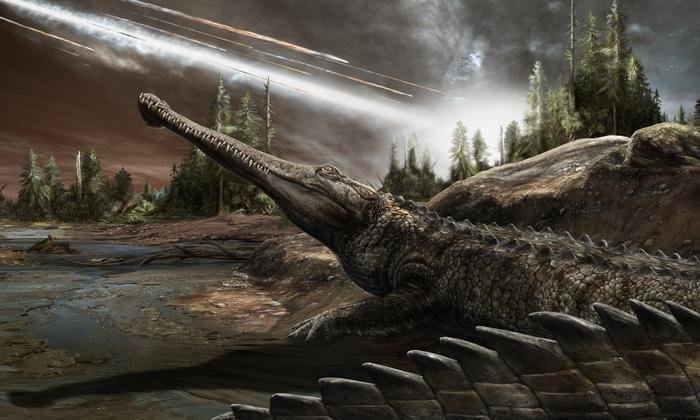
Crocodilian surviving dinosaur extinction. Image credit: Davide Bonadonna
The study, published in the journal Science Advances, examined more than 7,000 fossils and records of over 400 species, both living and extinct, and compared them with computer reconstructions of Earth’s climate and geography over 245 million years.
The team found that, rather than adapting to new climates, crocodiles and their relatives followed warm climates wherever they moved, spreading as far as Antarctica in hot periods and retreating to the tropics in colder ones.
The researchers also simulated how the climate might have changed following the asteroid impact 66 million years ago. They concluded that, in all but the most extreme scenarios, warm regions near the equator and in the subtropics stayed suitable for crocodile relatives.
Earlier modeling by members of the same team showed that suitable climates for non-avian dinosaurs (i.e., the ones that went extinct) shrank far more drastically.
Lead author Dr Alfio Alessandro Chiarenza, based at UCL Earth Sciences, said: “The asteroid did not make the whole planet equally hostile to every group.
“Crocodiles’ long-standing preference for warm environments may have placed survivors exactly where suitable climates held up best, like around the equator. These refuges could have sheltered populations that later recovered and radiated out.”
The crocodile lineage, known to scientists as pseudosuchians, appeared at a similar time as the dinosaurs, and has since survived two of Earth’s five mass extinctions.
Although crocodiles and their relatives appear very similar to each other today, the ancestors of this group were much more diverse, including heavily armored plant eaters, land-dwelling predators, and giants weighing more than a tonne.
Well-known pseudosuchians include the giant predator Sarcosuchus, the “super croc” that grew up to 12 meters long, and Postosuchus, which hunted solely on land and could move on two legs as well as on all fours.
Dr Chiarenza said: “Crocodiles are often called living fossils, but their ancestors and relatives changed enormously throughout their history, ranging from giants the size of a bus that could have devoured a T. rex, to small, cute animals with the face of a pug.
“Our study shows that, despite all this diversity, what stayed surprisingly consistent was their relationship with climate.”
For their study, the research team inferred the temperature and rainfall preferences of 400 species, using fossil records, evolutionary trees, and detailed mapping of where crocodile species live today. They then mapped these species’ suitable habitats over time, using reconstructions of Earth’s climate and geography.
They found that crocodile relatives largely* tracked warm climates around the globe. During the hothouse of the early Eocene, about 50 million years ago, when global temperatures were about 10°C higher than today and polar regions were ice-free, they lived at high latitudes in North America, Europe and Antarctica. When the planet cooled in the millions of years that followed, their range shrank back towards the tropics.
The researchers also looked at changes to climate in the tens or hundreds of years following the impact of the Chicxulub asteroid that killed most dinosaurs.
They tested several scenarios, including a dimming of the sun caused by ash and dust, and increased carbon dioxide due to volcanic eruptions. At 5% and 10% reduced sunlight, warm regions around the equator stayed suitable for crocodile relatives, but not at 15% less – although the researchers noted that this more extreme scenario is now considered unlikely. Other scenarios, such as increased carbon dioxide, did not affect climate suitability for crocodiles.
The authors stressed that climate alone did not explain why crocodiles survived. Smaller body size, semi-aquatic lifestyles, flexible diets and the low energy needs of ectothermic (“cold-blooded”) animals probably also helped.
Professor Philip Mannion, based at UCL Earth Sciences, said: “These findings have implications for species today. If crocodiles mostly coped with past climate change by moving towards suitable habitats, today’s species will need room to move as the planet warms, and the loss of suitable areas to roads, farms and cities is making that harder.”
The researchers received funding from The Royal Society, the Leverhulme Trust and the National Environment Research Council (NERC).
*The team discovered two exceptions to this pattern. During the Cretaceous Thermal Maximum about 94 million years ago, when global temperatures were up to around 14°C higher than today, one branch of the crocodile family tree adapted to hotter temperatures than the crocodile lineage could tolerate at other times.
Separately, around 34 million years ago, an extinct group of Australian crocodiles adapted to drier, desert-like conditions, as rainfall reduced due to a prolonged cooling interval and the continent dried out.
Written by Eddie Gonzales Jr. – MessageToEagle.com Staff Writer
Related Posts
-
 Plants That Survived Dinosaur Extinction Pulled Nitrogen From Air – Study
-
 Meet Fona Herzogae – Utah’s Underground Dinosaur Named After A Chamorro Creation Myth
-
 Frequent Fires Struck Antarctica During The Age Of Dinosaurs, 75 Million Years Ago – New Evidence
-
 Incredible Ancient Extinct World Of Unknown Organisms Discovered
-
 Ancient Giant Amphibians Swam Like Crocodiles 250 Million Years Ago – New Study
-
 500-Million-Year-Old Fossil Represents Rare Discovery Of Ancient Animal In North America
-
 Exquisitely Preserved Embryo Found Inside Fossilized Dinosaur Egg
-
 Earliest Evidence Of “Right-Handedness” In The Animal Kingdom
-
 New Species Of Dinosaur With Odd Sail-Like Structure On Its Back Discovered In Spain
-
 New Species Of Softshell Turtle That Lived In North Dakota 66.5 Million Years Ago With Dinosaurs Discovered

