
Astronomers Spot Unique Disc Of Debris That Foretells Solar System’s Future
Eddie Gonzales Jr. – MessageToEagle.com – Astronomers using the European Southern Observatory’s Very Large Telescope (ESO’s VLT) have found a rare disc of debris around a dead star that provides a glimpse of what may happen to our Solar System.
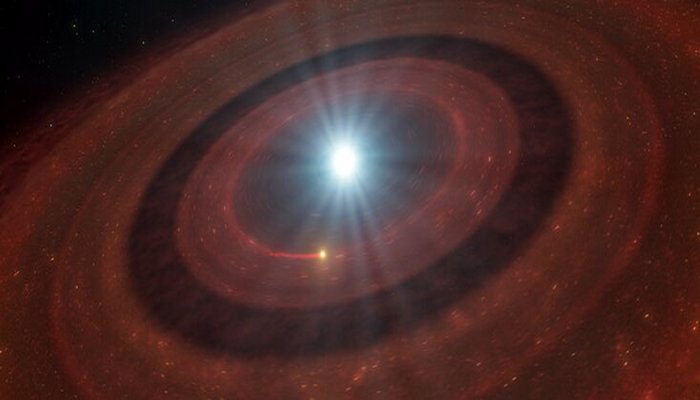
Artist’s impression of the debris disc around the white dwarf J1328-1450. Image credit: ESO/L. Calçada
Unlike in similar systems previously found, the debris — the leftovers of planets that once orbited the star — is organized in a double disc, the two parts separated by a clear gap. The disc appears to be shaped by two planetary bodies, one possibly as big as Pluto, that have survived the violent death of the star.
“We have known for some time that planets may survive beyond the transformation of their central star, but this is the first example of a complex system with a double debris disc and potentially two surviving planetesimals,” says Nicola Gentille Fusillo, astronomer at the Università degli Studi di Trieste, Italy, and lead author of the study published this week in Nature Astronomy. The central star is the white dwarf J1328-1450, the dense, burnt-out core left behind when a star similar to our Sun ran out of fuel.
As stars like the Sun enter the final stages of their life, they expand and shed their outer layers, engulfing and destroying nearby planets. The surviving rocky bodies can break apart forming a disc around the central, dead star. However, the disc around J1328-1450 is different from those observed around other dead stars: instead of having only one ring of vaporised planetary rubble, the star is surrounded by two concentric debris rings.
“The structure we see in this system is particularly intriguing because the two gaseous rings are remarkably stable and remain separated by a gap,” says co-author Felipe Lagos-Vilches, an astronomer at the University of Warwick, UK, and at the Universidad Técnica Federico Santa María in Chile. “The system is a rare glimpse of the violent, chaotic process by which a planetary system meets its end, and it hints that dead stars can have disc structures far more complex than previously realized,” adds Gentile Fusillo, who is also affiliated with the INAF-Astronomical Observatory of Trieste.
According to the team, this complex double structure is likely maintained by two surviving planet-like bodies, on separate orbits. They estimate that the one in the inner ring is the size of a typical asteroid, a few kilometers in diameter, while the outer one could be as large as Pluto, or even our Moon.
All known debris discs around white dwarfs have been identified by the same observational signature, which indicates a single, flat, rotating disc. But the new observations, made with the X-Shooter instrument on ESO’s VLT in Chile’s Atacama Desert, show that the J1328-1450 system breaks this pattern completely, revealing instead the unique fingerprint of a double disc.
The observations also show that elements such as calcium, oxygen, magnesium, and iron are present in the disc, indicating a composition similar to rocky planetary material in our own Solar System. Moreover, the data indicate that the two rings in the disc in fact have rather different compositions, with the inner ring rich in magnesium gas and the outer largely stripped of it. This suggests that the planetesimals that feed the rings originated from two planets with different compositions. An alternative explanation is that they come from different parts of a celestial body, like a planet’s crust and core.
Our Solar System could meet a similar end, as our Sun will, in the far future, become a white dwarf in a process that may destroy Earth. “The system therefore offers a remarkable glimpse of what the future of planetary systems, including systems like our own, might look like,” concludes Lagos-Vilches.
Written by Eddie Gonzales Jr. – MessageToEagle.com Staff Writer
Related Posts
-
 Origin Of Life Still Remains A Mystery – New Study Sheds More Light
-
 New Model Will Help Find Earth-Like Exoplanets
-
 Green Comet Last Seen By The Neanderthals 50,000 Years Ago May Be Visible To The Naked Eye This Week
-
 Iron-60 Discovery In Antarctic Ice Reveals The Mark Of The Local Interstellar Cloud
-
 Cosmic Danger – A Supernova Within 50 Light Years Would Kill Life On Earth
-
 Astronomers Discover Ancient Brown Dwarf With Lithium Deposits Intact
-
 Scientists Help Probe Dark Energy By Testing Gravity
-
 Shallow Lakes In Icy Crust Of Jupiter’s Moon Europa Could Erupt – New Study
-
 Total Amount Of Matter In The Universe – Precisely Measured
-
 Supermassive Black Holes Discovered In A Single Galaxy

