
Researchers Replicate The Bite Of Ancient Marine Predators
Eddie Gonzales Jr. – MessageToEagle.com – How can we reconstruct the hunting strategies of extinct predators? A multidisciplinary team of paleontologists, biologists, and engineers from ULiège has provided an answer to this question.

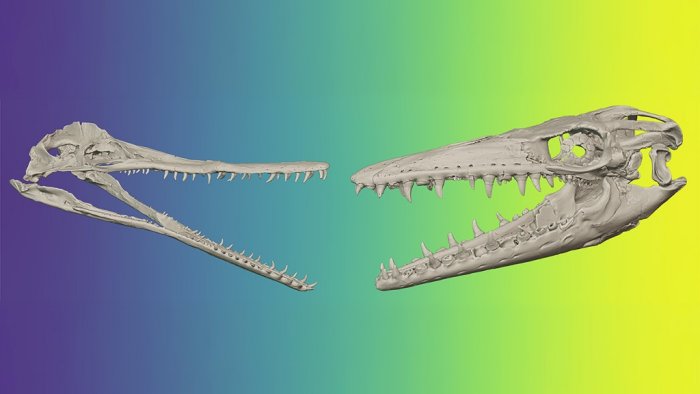
Biting performance of North American mosasaurs and plesiosaurs, showing optimal (bright colors) or suboptimal (darker colors) biting performance. | © University of Liège / F.Della Giustina
By combining paleontological data with 3D modeling and cutting-edge engineering simulations, the team has recreated the biting behavior of marine predators that inhabited the vast sea that covered North America approximately 80 million years ago.
“ Every ecosystem, even underwater, has limited food resources for predators ,” explains Francesco Della Giustina, a paleontologist and doctoral student at the EDDy Lab . “ The simultaneous presence of several large predators in North America during the Cretaceous period over a long period suggests that they occupied subtly different ecological roles, targeting different types of prey rather than competing directly with each other. While paleontologists have long formulated such hypotheses, new technologies now allow us to test them quantitatively .”
The research team created 3D models of the skulls and mandibles of marine reptiles that coexisted in this ancient sea: plesiosaurs and mosasaurs. The cranial musculature of each species was reconstructed, and the strength of each muscle involved in jaw closure was estimated. The team then applied a computational method from engineering called finite element analysis to simulate the stresses and deformations of the bones during biting under realistic conditions.
University of Liège / F. Della Giustina
This allowed the researchers to observe the mechanical behavior of the jaws in many different species. The team identified marked differences in biting performance among these predatory species, differences that reflect distinct capabilities and, consequently, likely distinct behaviors. Some species likely occupied a niche as apex predators (feeding on almost all other elements of the food chain), while others appear to have specialized in consuming small, soft, and agile prey, such as small fish or certain cephalopods (e.g., squid).
“ The mechanical study of the skull provides essential information about the ecological role of these animals ,” adds Francesco Della Giustina. “ We can now test, in a virtual environment, behaviors that would otherwise remain inaccessible in the fossil record. This opens up new perspectives on how these predators lived, interacted, and evolved .”
In other words, by combining fossils with modern technologies, researchers are beginning to reconstruct how these ancient animals functioned as living organisms, bringing us closer than ever to understanding life in prehistoric oceans.
https://www.sciences.uliege.be/cms/c_13670661/fr/reproduire-la-morsure-des-anciens-predateurs-marins
Written by Eddie Gonzales Jr. – MessageToEagle.com Staff Writer
Related Posts
-
 A Giant New Species Of Long-Necked Herbivorous Dinosaur Discovered By Argentine Paleontologists
-
 New Species Of Dinosaur With Odd Sail-Like Structure On Its Back Discovered In Spain
-
 Quarter-Ton Marsupial Roamed Long Distances Across Australia’s Arid Interior, Reveals 3D-Scanning Study
-
 Giant Human-Sized Penguins Ruled The World After Dinosaurs Died Out
-
 Oldest Polar Sea Reptile Fossil Ever Found In Southern Hemisphere
-
 Dinosaur Footprints Matched Across Atlantic Ocean
-
 Nanotyrannus Was Not A Juvenile T. Rex – New Study Reveals
-
 Ouray In Colorado – Looping Long-Necked Dinosaur Site Reveals Its Secrets
-
 The World’s Oldest RNA Extracted From Woolly Mammoth
-
 Giant Meat-Eating Dinosaur Footprint Found In Yorkshire Could Be The Largest Ever

