
Amasia – New Future Supercontinent
Question: When will a new supercontinent form on Earth?
Answer: Scientists have already named our next new supercontinent. It’s name is Amasia.
Geological record reveals that in the past 2 billion years, there have been three supercontinents. The oldest known supercontinent, Nuna, came together about 1.8 billion years ago. The next, Rodinia, existed about 1 billion years ago, and the most recent, Pangaea, came together about 300 million years ago.
See also: Stunning View Of What Supercontinent Pangea Looks Like Mapped With Modern Borders
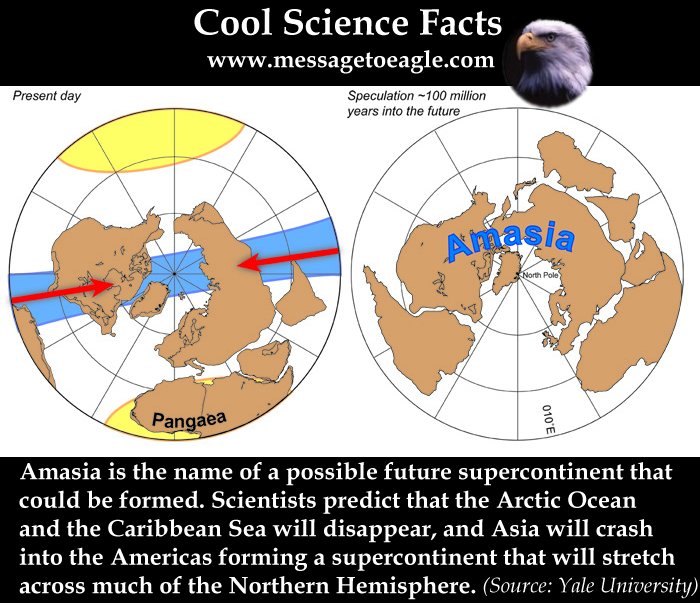
Amasia, is a possible future supercontinent that could be formed. Scientists predict that the Arctic Ocean and the Caribbean Sea will disappear, and Asia will crash into the Americas forming a supercontinent that will stretch across much of the Northern Hemisphere.
This prediction relies mostly on the fact that the Pacific Plate is already subducting under Eurasia and North America, a process which if continued will eventually cause the Pacific to close.
Previous studies suggest that supercontinents last about 100 million years or so before they break apart, setting the pieces adrift to start another cycle.
MessageToEagle.com
Source:
Related Posts
-
 Kim Ung-Yong – The Man With World’s Highest IQ Has A Message To All People
-
 Black Plants Could Exist On Alien Worlds With Two Suns
-
 El Niño And Its Effects On The Planet
-
 Seamounts: Gigantic Elevations More Than 1,000 Meters High At The Bottom Of Ocean
-
 Tiktaalik Roseae: A 375-Million-Year-Old Fish Had Fins For Walking
-
 Ring Of Fire: Gigantic Zone Of Frequent Earthquakes And Volcanic Eruptions
-
 Angel Falls Is The World’s Highest Waterfall
-
 Mirny Diamond Mine: World’s Largest Open Pit Mine
-
 HD 189733b: A Blue Marble Planet Where It Rains Super-Hot Glass
-
 Phenomenon Of True Polar Wander: What Is It?

