
Cairn de Barnenez: Europe’s Largest Megalithic Mausoleum Is One Of The World’s Oldest Man-Made Structures
MessageToEagle.com – The name of Europe’s largest megalithic mausoleum is Cairn de Barnenez.
Located the Bay of Morlaix, Britanny, France, we find some of the world’s oldest burial chambers.
This fascinating ancient place pre-dates the Egyptian pyramids and is considered the second oldest monument in the world, only a little younger than the Tower of Jericho.
European Megalithic tombs of the Neolithic and early Bronze Age are found predominantly in the lands bordering the Atlantic and the North Sea. These ancient tombs can be found in Spain, Portugal, France, Britain, Ireland, Holland, Germany, Denmark and Sweden.
Structures similar to the Cairn de Barnenez megalithic mausoleum cannot be found in Central, East or South-East Europe.
The Cairn de Barnenez complex was built in in two separate stages, which explains why there are two different types of burial chambers at the site.
The oldest chambers were constructed around 4,500 B.C. and are made of dolerite, an igneous rock generated from the cooling and solidification of molten Earth material. It is also referred to as a volcanic rock.
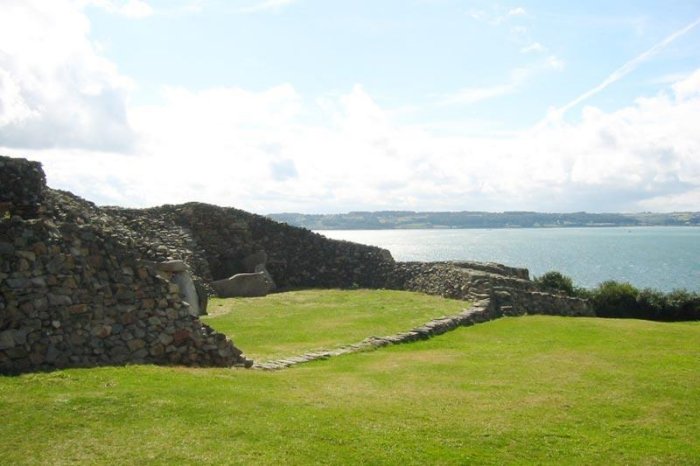
The other burial chambers that can be found at Cairn de Barnenez were made a few hundred years later using granite from the Île de Sterec.
French writer and politician André Malraux called this remarkable ancient site “the Prehistoric Parthenon” and with good reason.
The entire French mausoleum consists of a 75 meters (246ft) corridor that is 28 meters (91ft) wide and 8 meters (26ft) high.
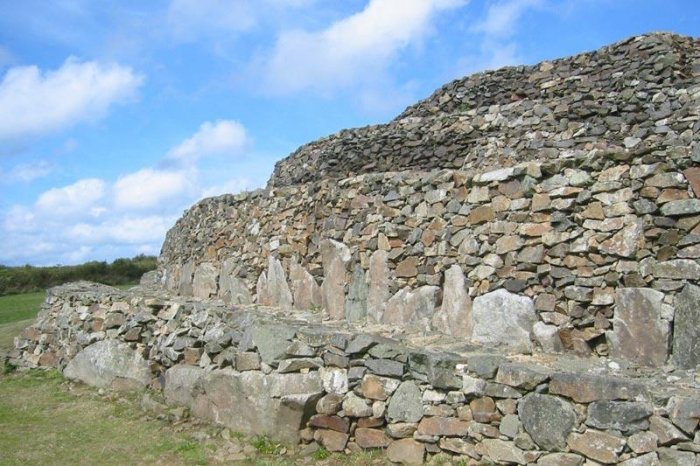
About 13,000 to 14,000 tons of stone were required to construct this amazing site. Many intriguing ancient symbols are carved on the stones in the chambers and passages. Some of the ancient carvings depict bows, axes, wave symbols or snakes and a repeated U-shaped sign.
See also:
Mysterious Megalithic Stones Of Carnac, France – An Unsolved Neolithic Enigma
Traces Of Europe’s Mysterious Ancient Lost Civilization In The Fontainebleau Forest
More Fascinating Ancient Mysteries
Today, classified as a National Monument Cairn de Barnenez was first mapped in 1807. In 1850, scientists classified it as a tumulus, a mound of earth and stones raised over a grave or graves. In 1950, the cairn was used as a quarry for paving stones. This activity, which threatened to destroy the monument, was only halted after the discovery of several of its chambers in the 1950s.
Between 1954 and 1968 archaeologists conducted excavations at the site and unearthed interesting Neolithic pottery, axes and arrowheads as well as Bronze Age pottery. Anyone who visits the site, can admire some of these ancient artifacts at the visitors’ center.
MessageToEagle.com
Expand for references
Related Posts
-
 Indigenous People Of Ancient Sicily Were Acrive Traders Long Before The Greeks Arrived
-
 Rare Trove Of Ancient Metal Objects Unearthed In Mississippi Was Left By The Spaniards When The Chickasaws Attacked
-
 Cusco: A Complex Of Ancient Inca Platforms Discovered In Ollantaytambo, Peru
-
 Unraveling Secrets Of Ancient Egypt With ‘Scan Pyramids’ Project
-
 Late Neolithic Italians Mastered Complex Metal Technologies – New Study
-
 New DNA Study Reveals How The Black Rat Colonized Europe In The Roman And Medieval Periods
-
 Evidence Ravens Share A 30,000-Year-Old Relationship With Humans
-
 DNA Study Sheds New Light On The Ancient Teotihuacans
-
 History Set In Stone – Maya Rulers Put Their Personal Stamp On Ancient Monuments
-
 Story About Cahokia’s Lost Civilization Is Wrong – Archaeologist Says

