
Flying Reptile With A Wingspan Of Up To 10 Meters Dominated North America’s Skies 75 Million Years Ago
Eddie Gonzales Jr. – MessageToEagle.com – A newly identified species of pterosaur is among the largest ever flying animals, according to a new study from the Queen Mary University of London.
Cryodrakon boreas, from the Azhdarchid group of pterosaurs (often incorrectly called ‘pterodactyls’), was a flying reptile with a wingspan of up to 10 meters which lived during the Cretaceous period around 77 million years ago.
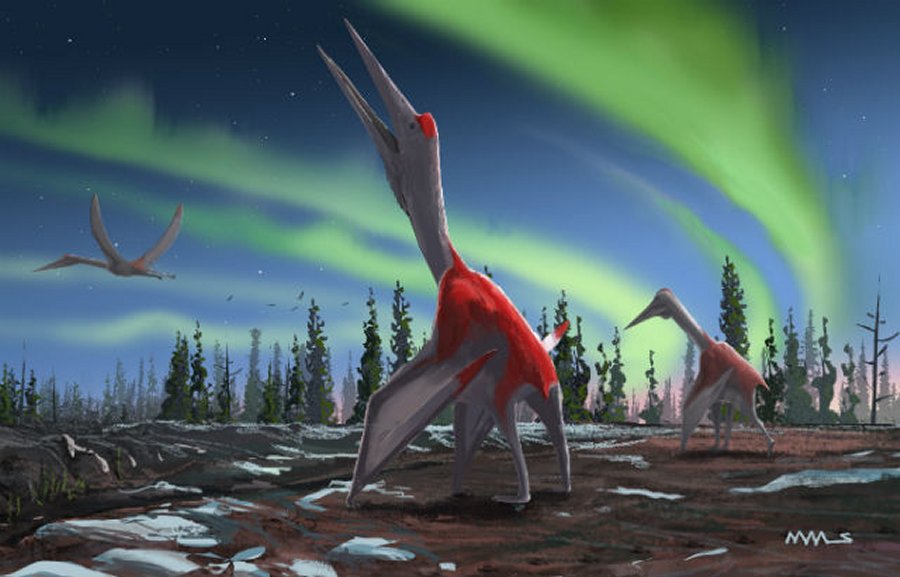
Its remains were discovered 30 years ago in Alberta, Canada, but paleontologists had assumed they belonged to an already known species of pterosaur discovered in Texas, USA, named Quetzalcoatlus.
“This is a cool discovery, we knew this animal was here but now we can show it is different to other azhdarchids and so it gets a name, ” Dr. David Hone, lead author of the study from the Queen Mary University of London, said in a press release.
The main skeleton is from a young animal with a wingspan of about 5 meters but one giant neck bone from another specimen suggests an adult animal would have a wingspan of around 10 meters.
This makes Cryodrakon boreas comparable in size to other giant azhdarchids including the Texan Quetzalcoatlus which could reach 10.5 m in wingspan and weighed around 250 kg.
Although the remains — consisting of a skeleton that has part of the wings, legs, neck and a rib — were originally assigned to Quetzalcoatlus, the study of this and additional material uncovered over the years shows it is a different species in light of the growing understanding of azhdarchid diversity.
Like other azhdarchids these animals were carnivorous and predominantly predated on small animals which would likely include lizards, mammals, and even baby dinosaurs.
“It is great that we can identify Cryodrakon as being distinct to Quetzalcoatlus as it means we have a better picture of the diversity and evolution of predatory pterosaurs in North America,” Dr Hone added.
Unlike most pterosaur groups, azhdarchids are known primarily from terrestrial settings and, despite their likely capacity to cross oceanic distances in flight, they are broadly considered to be animals that were adapted for, and lived in, inland environments.
Written by Eddie Gonzales Jr. – MessageToEagle.com Staff
Related Posts
-
 New Discovery Pushes Origin Of Feathers Back By 70 Million Years
-
 T. rex’s Fancy Footwork Owed To Special Ligaments – New Study
-
 Your Pet Does Have A Facial Expression And You Can Learn How To Read It
-
 Clown Anemonefish May Master Simple Math And Count Stripes On Other Fish
-
 Scaling Laws In Enzymes May Help Predict Life ‘As We Don’t Know It’
-
 New Feathered Dinosaur Lived In New Mexico 67 Million Years Ago
-
 Growing Mushrooms Alongside Trees Can Produce A Valuable Food Source For Millions Of People
-
 Plants Are Intelligent And Decide When To Grow And Not
-
 Dinosaurs Took Over Amid Ice, Not Warmth – A New Study
-
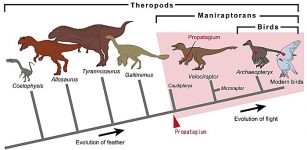 How Birds Got Their Wings – Study Focuses On The Origin Of bird Flight

