
Kunbarrasaurus: New Armoured Dinosaur Revealed
MessageToEagle.com – Meet the Kunbarrasaurus – a new armoured dinosaur that once roamed the Earth. It has a parrot-like beak, bones in its skin and an inner ear that is proportionately enormous and unlike anything scientists have seen before in a dinosaur. It looks more like the inner ear of a Tuatara or a turtle.
The skeleton of Kunbarrasaurus (koon-ba-rah-sore-rus) was discovered in 1989, but new research from a team led by University of Queensland experts has revealed the dinosaur is a distinctly different species than previously thought.
The dinosaur lived in Australia and it was a unique type of animal.
UQ School of Biological Sciences PhD student Lucy Leahey said the fossil represented the most complete dinosaur so far discovered in Australia and one of the best-preserved ankylosaur fossils in the world.
“Ankylosaurs were a group of four-legged, herbivorous dinosaurs, closely related to stegosaurs,” Ms Leahey said.
“Like crocodiles, they had bones in their skin and are commonly referred to as ‘armoured’ dinosaurs.”
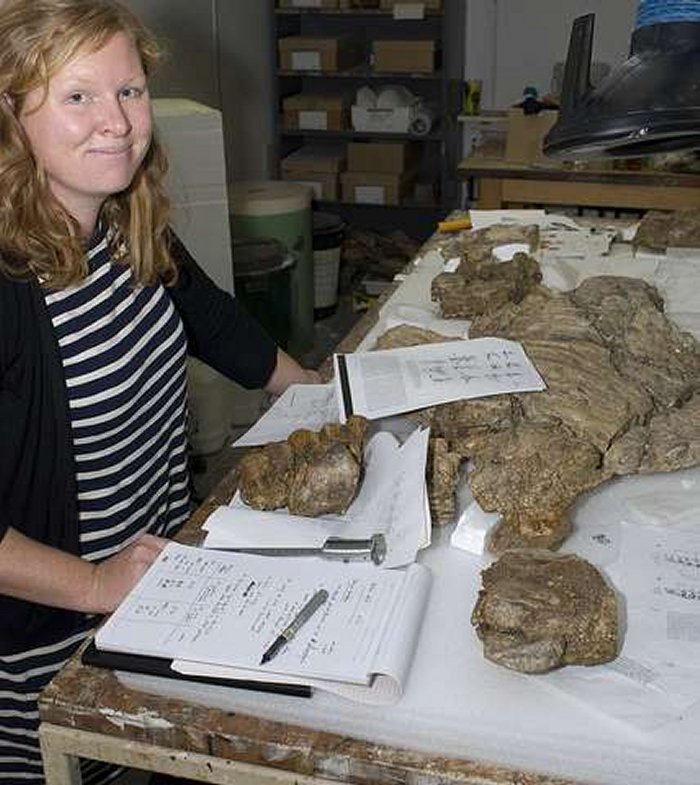
“When it was first studied back in the 1990s, the fossil was placed it in the same genus as Australia’s only other named ankylosaur, Minmi, which is based on some bones from Roma in south-western Queensland.”
The team’s research found the fossil was different to the Roma Minmi, and distinct enough from all other ankylosaurs to warrant a new name.
“Kunbarra is the word for ‘shield’ in the Mayi language of the Wunumara people from the Richmond area, and the species name honours the person who originally found the fossil, Mr Ian Ievers. It means ‘Ievers’ shield lizard,” Ms Leahey said.
Research that started in 2007 involved careful preparation of the palate of the dinosaur at the Denver Museum of Nature and Science, along with CT scanning at the Mater Adult Hospital.
Professor Lawrence Witmer from the Ohio University Heritage College of Osteopathic Medicine used the information to create a 3D reconstruction of the brain, inner ear and nasal cavities, which can be viewed here.
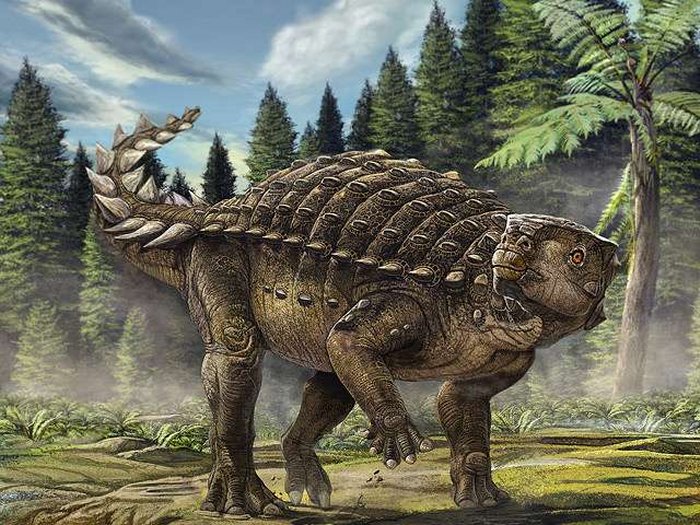
“The CT reconstruction revealed that Kunbarrasaurus had a more complicated airway than other dinosaurs, but less so than ankylosaurs from the Northern Hemisphere,” Professor Witmer said.
Scientists say the Kunbarrasaurus specimen should be considered as a new dinosaur.
See also:
Rare Giant 170-Million-Year-Old Dinosaur Footprints Found On Isle Of Skye
Rare Fossil Of Dog-Sized Horned Dinosaur From “Lost Continent” Identified By Scientists
“Our work has also revealed that Kunbarrasaurus is more primitive than the majority of other well-known ankylosaurs from North America and Asia.”
“It appears to represent an early, less heavily ‘armoured’ member of the group, close to the point at which the ankylosaurs diverged from the other main lineage of armoured dinosaurs, the stegosaurs.”
The skeleton of Kunbarrasaurus ieversi is on display at the Queensland Museum (Southbank).
The research is available online in the open access journal PeerJ.
MessageToEagle.com
Source:
Related Posts
-
 Quantum Machine Will Study All Possible Futures Simultaneously
-
 Amazing New Shape-Shifting Material – It Changes Shape Using Heat And Light
-
 New Controversial Blood Test Determining How Long You Will Live Is Entering The Market
-
 Nanotyrannus Was Not A Juvenile T. Rex – New Study Reveals
-
 New Version Of Chess Invented – Pieces Move Diagonally Across The Game Board
-
 500-Million-Year-Old Sea Worm Named After ‘Dune’ Monster Was Unknown To Science Until Now
-
 Oldest And Never-Before-Seen Bat Species Lived In Wyoming 52 Million Years Ago – Fossils Reveal
-
 Adorable Animation Video Showing How Rosetta And Philae Investigate A Comet
-
 Nine Climate Tipping Points Are Now Active – Scientists Warn
-
 Web Of Cosmic Dark Matter Has Been Identified In The Coma Cluster

