
Size Of “Small” Rosetta’s Comet Compared To Los Angeles
MessageToEagle.com – There are hundreds of comets flying around the Solar System and Rosetta’s Comet is rather small compared to other enormous objects that exists in space.
But, if we compare the size of Rosetta’s Comet to for example a city like Los Angeles the object is huge!
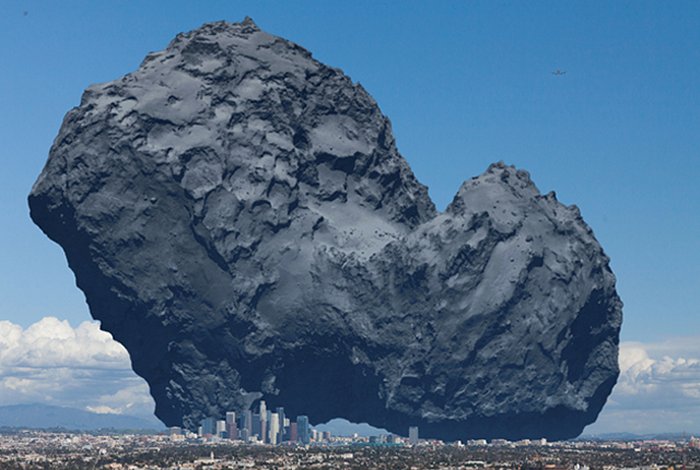
Named after its discoverers, Churyumov-Gerasimenko the body of Comet 67P/C-G, is about as long as Central Park in New York!
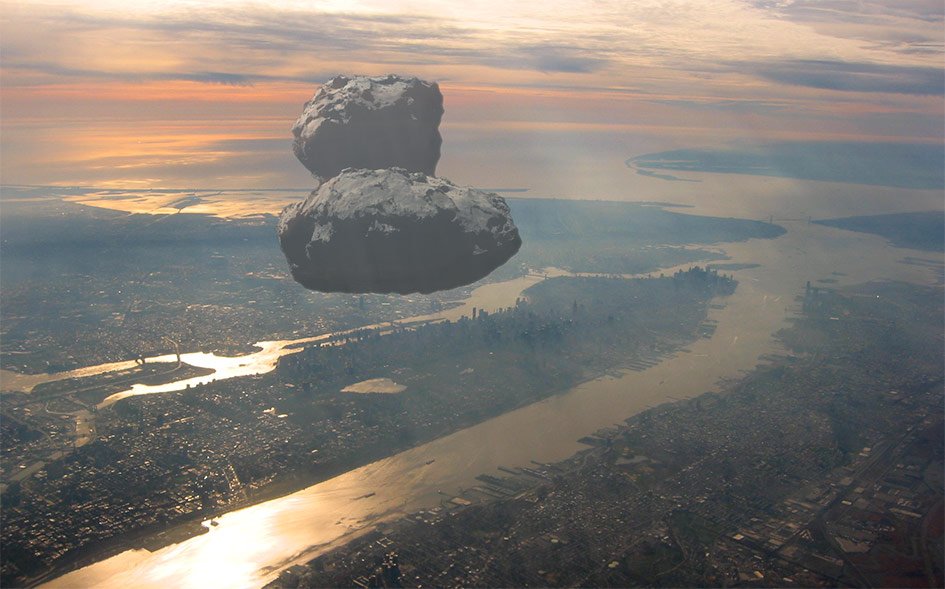
Comet 67P is one of numerous short period comets which have orbital periods of less than 20 years and a low orbital inclination. Since their orbits are controlled by Jupiter’s gravity, they are also called Jupiter Family comets.
See also:
Boss Great Wall: Gigantic Wall Of Galaxies Located In Deep Space
Comet Hyakutake Has The Longest Tail Ever Recorded
These comets are believed to originate from the Kuiper Belt, a large reservoir of small icy bodies located just beyond Neptune. As a result of collisions or gravitational perturbations, some of these icy objects are ejected from the Kuiper Belt and fall towards the Sun.
When they cross the orbit of Jupiter, the comets gravitationally interact with the massive planet. Their orbits gradually change as a result of these interactions until they are eventually thrown out of the Solar System or collide with a planet or the Sun.
Rosetta’s comet never crosses the Earth’s orbit so there is no danger of a collision, at least until a close encounter with some other planet shifts its orbit. Unfortunately the same cannot be said for other, even larger, asteroids and comets and these space objects are a potential threat to our planet.
MessageToEagle.com
Expand for referencesRelated Posts
-
 Sun Is Likely An Unaccounted Source Of The Earth’s Water – New Study
-
 Hubble Finds Evidence Of Persistent Water Vapor In One Hemisphere Of Europa
-
 Looking For Habitable Planets Around Alpha Centauri
-
 Astronomers Detect Signs Of Water In Most Massive Galaxy Of Early Universe
-
 Black Hole Found Hiding In Star Cluster Outside Our Galaxy
-
 Worlds With Underground Oceans Support, Conceal Life – New Study
-
 ‘Oumuamua – Interstellar Alien Object That Remains A Mystery
-
 Subaru Telescope Discovers “Fossil” In Outer Solar System
-
 Unique Metal-Rich Psyche Asteroid – Its First Temperature Map Obtained From Earth
-
 Webb Reveals Distorted Galaxy Forming Cosmic Question Mark

