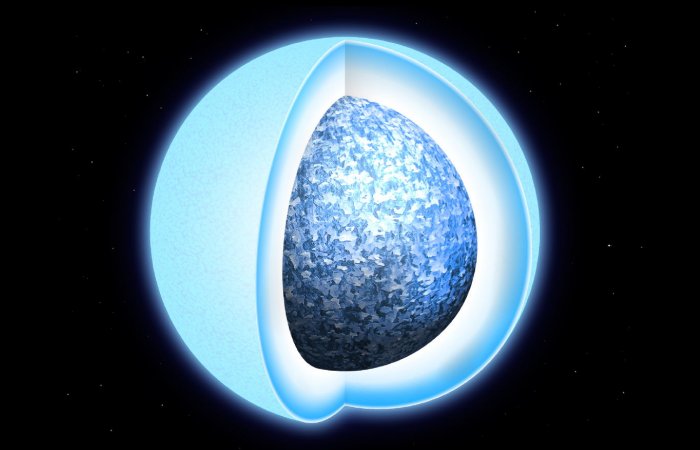
White dwarf star in the process of solidifying. Credit: University of Warwick/Mark Garlick

First Direct Evidence Of White Dwarf Stars Turning Into Crystals

MessageToEagle.com – The first direct evidence of white dwarf stars solidifying into crystals has been discovered by astronomers at the University of Warwick, and our skies are filled with them. Using data from observations made by the ESA’s Gaia satellite, the

Pulsar encased in supernova bubble. Image credit: ESA/XMM-Newton/ L. Oskinova/M. Guerrero; CTIO/R. Gruendl/Y.H. Chu

ESA Sets Clock By Distant Spinning Neutron Stars

MessageToEagle.com – ESA’s technical centre in the Netherlands has begun running a pulsar-based clock. The ‘PulChron’ system measures the passing of time using millisecond-frequency radio pulses from multiple fast-spinning neutron stars. Operating since the end of November, this pulsar-based timing system

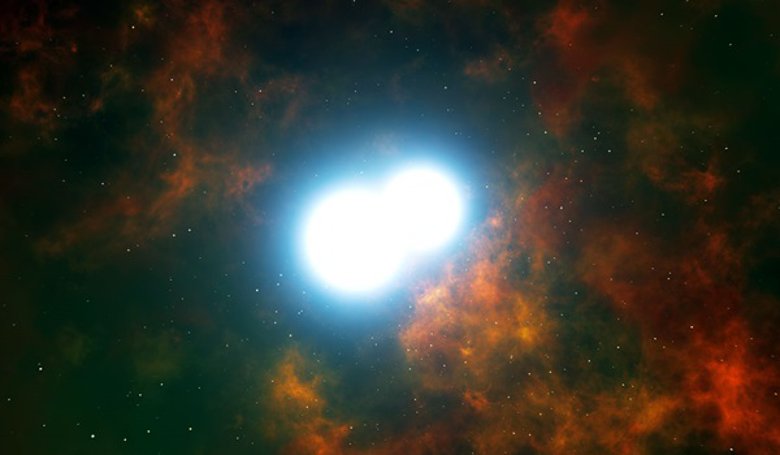
Two white dwarfs in a binary system can spiral toward each other and merge, initiating a supernova explosion. Image: ESO/L. Calçada

Fastest Stars In The Galaxy Spotted With ESA’s Gaia Satellite

MessageToEagle.com – An international team of astronomers using ESA’s Gaia satellite, spotted some candidates for fastest stars in the Milky Way. Just last week, mission specialists behind ESA’s Gaia satellite announced the unveiling of information on over 1.6 billion stars in our galaxy to an

This image, taken with the Wide Field Planetary Camera 2 on board the NASA/ESA Hubble Space Telescope, shows the galaxy NGC 6052, located around 230 million light-years away in the constellation of Hercules. Credit: ESA/Hubble & NASA, Acknowledgement: Judy Schmidt (Geckzilla)

Hubble Presents: Galaxy NGC 6052 Located In The Constellation Of Hercules

MessageToEagle.com – The Wide Field Planetary Camera 2 (WFPC2) was Hubble’s workhorse camera for many years. One of Hubble’s most important instruments was used to observe just about everything. WFPC2 delivered many of the most famous Hubble pictures. This image, taken with the Wide