What Lies Beneath The Surfaces Of Uranus and Neptune?

What Lies Beneath The Surfaces Of Uranus and Neptune

Eddie Gonzales Jr. – MessageToEagle.com – Diamond rain? Super-ionic water? These are just two proposals that planetary scientists have come up with for what lies beneath the thick, bluish, hydrogen-and-helium atmospheres of Uranus and Neptune, our solar system’s unique but

Uranus and Neptune. NASA’s Voyager 2 spacecraft captured these views of Uranus (on the left) and Neptune (on the right) during its flybys of the planets in the 1980s. Credit: NASA/JPL-Caltech/B. Jónsson

Scientists Explain Why Uranus And Neptune Are Different Colors

Eddie Gonzales Jr. – MessageToEagle.com – Observations from Hubble Space Telescope, the NASA Infrared Telescope and the Gemini Observatory, reveal that excess haze on Uranus makes it paler than Neptune and that dark spots are caused by a darkening of

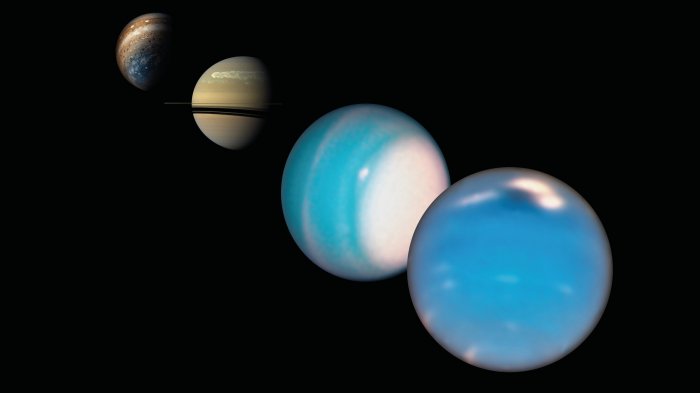
Composite image of Neptune, Uranus, Saturn and Jupiter. Credit: Jupiter from Juno: NASA/SwRI/MSSS/Gerald Eichstädt/Seán Doran; Saturn from Cassini: NASA/JPL-Caltech/Space Science Institute; Uranus and Neptune from HST: NASA/ESA/A. Simon (NASA Goddard Space Flight Center), and M.H. Wong and A. Hsu (University of California, Berkeley)

Mushballs Stash Away Missing Ammonia On Uranus And Neptune

Eddie Gonzales Jr. – MessageToEagle.com – Mushballs—giant, slushy hailstones made from a mixture of ammonia and water—may be responsible for an atmospheric anomaly on Neptune and Uranus that has been puzzling scientists. Composite image of Neptune, Uranus, Saturn and Jupiter.

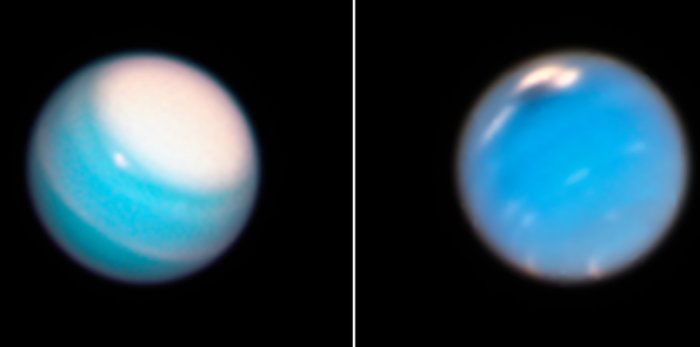
Mysterious dark storm on Neptune (right) and provided a fresh look at a long-lived storm circling around the north polar region on Uranus (left). Credits: NASA, ESA, A. Simon (NASA Goddard Space Flight Center), and M.H. Wong and A. Hsu (University of California, Berkeley)

NASA’s Hubble Reveals Dynamic Atmospheres Of Uranus, Neptune

MessageToEagle.com – A new mysterious dark storm on Neptune (right) and provided a fresh look at a long-lived storm circling around the north polar region on Uranus (left) was uncovered by NASA’s Hubble Space Telescope. Like Earth, Uranus and Neptune have

A 2004 infrared composite image of the two hemispheres of Uranus obtained with Keck Telescope adaptive optics. Credit: Lawrence Sromovsky, University of Wisconsin-Madison/W.W. Keck Observatory.

‘Cataclysmic’ Collision Shaped Uranus’ Evolution

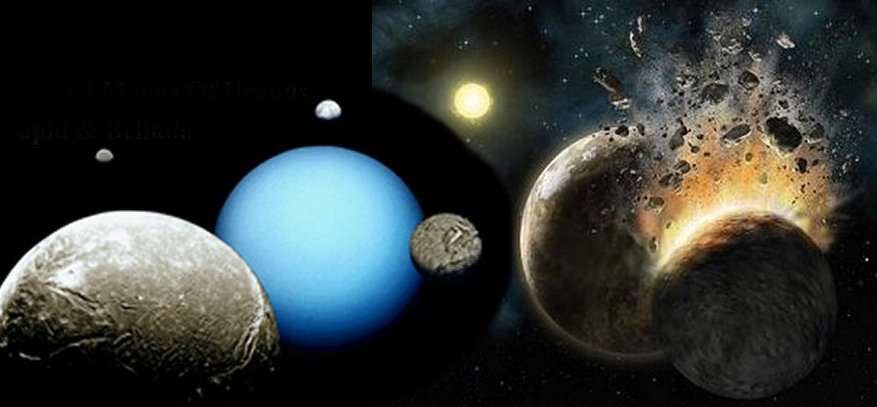
MessageToEagle.com – Uranus was hit by a massive object roughly twice the size of Earth that caused the planet to tilt and could explain its freezing temperatures, according to new research. Astronomers at Durham University, UK, led an international team of

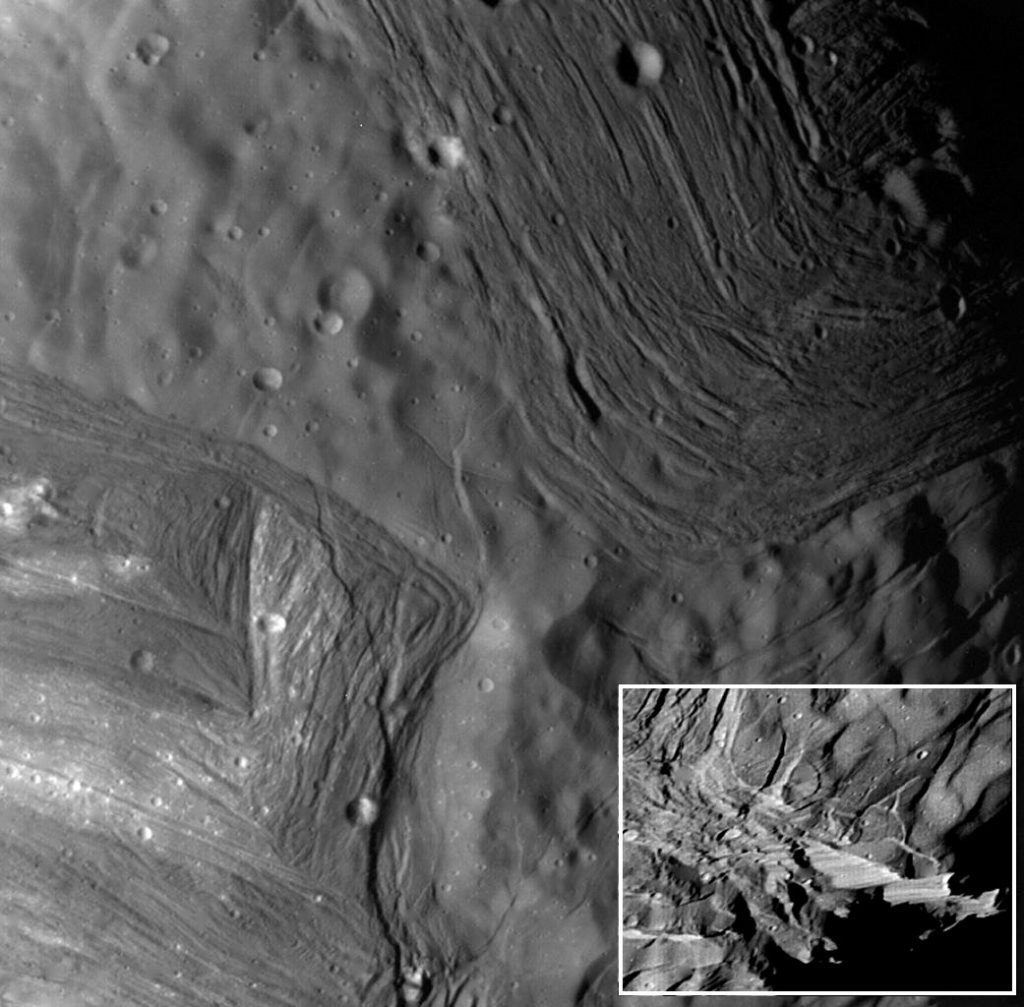
Mirandassurface12chevronfeat 1024x1007

Miranda: Probably The Strangest Of Uranus’ Moons  

A. Sutherland – MessageToEagle.com – Five large moons and at least 22 small moons orbit Uranus, but probably the strangest of them is Miranda. It is a small moon but its surface is really amazing. Miranda, which reveals a complex

Coldestplacessolsyst1

Never Ending Winter In Our Solar System

MessageToEagle.com – There’s no lack of ice in our solar system. Frozen water can be found almost everywhere: the poles of Mercury, Earth, the moon and Mars; the rings and icy satellites of the outer planets; and in comets that

Uranus Neptune

Winds On Uranus And Neptune Can Reach Supersonic Speeds

Question: Where in our solar system are the strongest winds? Answer: Giant planets in the outer solar system, like Uranus and Neptune, are dominated by winds that can reach supersonic speeds and jet streams 10 to 15 times stronger than