
Walk Farther, Land Harder: The Heel-Strike Strategy That Extended Human Range
Eddie Gonzales Jr. – MessageToEagle.com – Most people walk heel to toe, taking thousands of steps each day. A new study shows that heel-first walking is more uniquely human than previously thought. This adaptation let early hominins walk farther and more efficiently, though it increased impact on bones and joints.
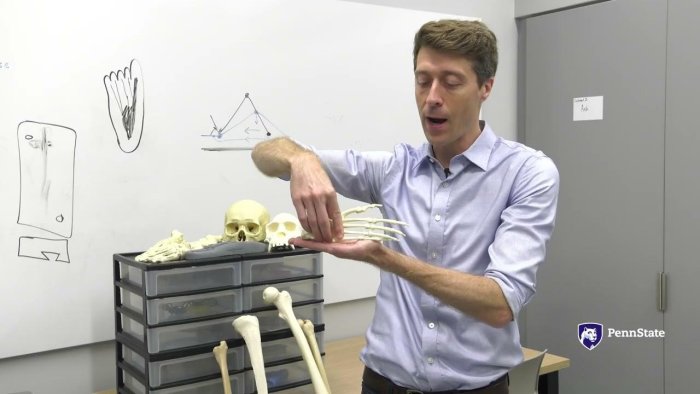
Consistent heel-to-toe steps set early humans apart from their closest great ape relatives and allowed them to walk farther more efficiently, but at the cost of higher impact forces to bones and joints, according to a new study led by Nicholas Holowka, assistant professor of anthropology at Penn State. The researcher explains the evolution of the heel-to-toe walking style. Credit: Ben Manning/Penn State.
The team’s findings highlight an evolutionary adaptation that improved early human walking efficiency, supporting the development of hunting and gathering and enabling global migration.
Previous research suggests that humans share the heel-strike walking style with other great apes, including chimpanzees. Using high-speed video and a runway with force-measuring plates to analyze chimpanzee and human walking patterns, the team found that chimpanzees usually land on the side or ball of the foot when walking on two legs, using a heel-strike less often than when moving on all fours. Humans consistently use a heel-strike, instead. This walking style saves humans an estimated 26% to 41% of the metabolic energy compared to walking on the ball of the foot, but it also produces higher impact forces. As a result, humans developed larger, stronger bones and joints, adaptations that enabled early humans to travel farther safely and consistently.
The earliest human ancestors probably walked like chimpanzees do, with less steady and more varied foot landings, sometimes on the front of their feet or flat, and other times on their heels, said Holowka. He said this way of walking was less efficient than how modern humans walk and likely limited how far they could go. He added that the heel strike is much more efficient because it lets humans roll smoothly from the back of the foot to the front. But it also creates stronger impact forces that quickly put more stress on the leg.
“Imagine you are trying to sneak across a creaky wooden floor,” said study co-author Nathan Thompson, an associate professor at New York Institute of Technology, College of Osteopathic Medicine. “You tend to walk on the balls of your feet, because this reduces the rate of loading on the floor and creates less creaking. It’s a softer way to walk.”
These more impactful forces could have damaged the body and ultimately required later adaptations that allowed early humans to walk safely and consistently, according to the researchers.
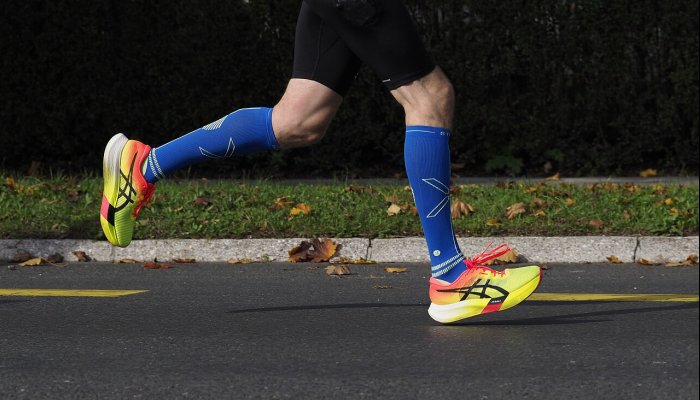
Rear-foot strike also known as “heel strike”. Image credit: – CC BY-SA 4.0
Holowka thinks that humans appear to have evolved anatomical adaptations, such as thicker heel bones and larger knee and ankle joints, to withstand these high forces. Also heel-strike contributed to key human behaviors, such as hunting and gathering strategies that required walking long distances daily for significant food rewards.
At Stony Brook University, the researchers set up a 36-foot walkway with metal force plates and high-speed cameras to study how three male chimpanzees walked on all fours and on two legs. They also included walking data from three more chimpanzees collected by another team, and reviewed results from two other studies, bringing their total sample to 15 chimpanzees.
The team also recruited 12 human participants for similar laboratory experiments at the University at Buffalo. Nine participants wore reflective markers and walked barefoot on an approximately 25-foot-long runway lined with force plates and high-speed, high-resolution cameras.
“It seems that when walking on two legs, chimpanzees prefer the ‘softer’ way to land on their feet,” Thompson said.
All normal human walking steps landed on the heel, with the foot touching the ground at a very similar angle both within and between people. Chimpanzees, however, showed 2.4 to 8.6 times more variation in the angles at which their feet hit the ground, the researchers reported.
The team also found that heel strikes generated much higher impact forces than midfoot strikes in both chimpanzees and humans. In chimpanzees walking on two legs, the rate of impact force loading ranged up to 138% higher for heel-strikes than midfoot-strikes. In humans, these forces ranged up to 162% higher than midfoot-strikes. However, walking heel-first saved human participants an estimated 26% to 41% in expended metabolic energy compared with midfoot strikes.
“We humans have evolved to use this high-impact walking style in a way that is safe and natural for us,” Holowka said.
“The novel environments that we currently live in with their hard, paved surfaces might upset the evolutionary balance in some ways. It’s something that we’d be interested in looking at in future research. Still, walking a lot is a very healthy exercise and, although high impact, our bodies evolved to cope with it, so we shouldn’t avoid it.”
Written by Eddie Gonzales Jr. – MessageToEagle.com Staff Writer
Related Posts
-
 Smallest Arm Bone In Human Fossil Record Illuminates Homo floresiensis Origin
-
 Our Lineage’s Species Formation Pattern Was Unlike Anything Else
-
 Surprisingly Complex History Of Crocodiles – New Study
-
 Study Explains How Part Of The Nucleolus Evolved
-
 Cats’ Purrs Reveal Who’s Who Better Than Their Meows
-
 Sinuses Prevented Prehistoric Crocodile Relatives From Deep Diving
-
 Did A Weak Magnetic Field 600 Million Years Ago Trigger The Emergence Of Animals?
-
 When And How Pterosaurs Went From Tiny Tree-Climbers To Towering Terrestrial Titans
-
 Animals May Have Evolved Up To 200 Million Years Earlier Than Fossil Evidence Suggests
-
 Disappearance Of Mastodons Still Threatens South America’s Native Forests

