
Why Are The Billions Of Years Old Moeraki Boulders So Perfectly Round?
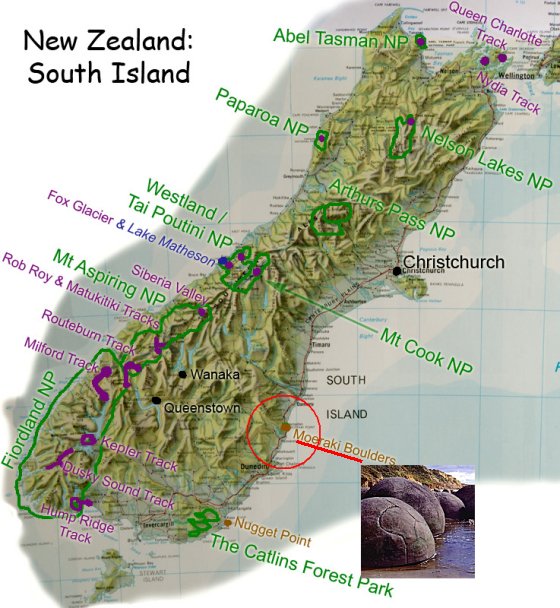
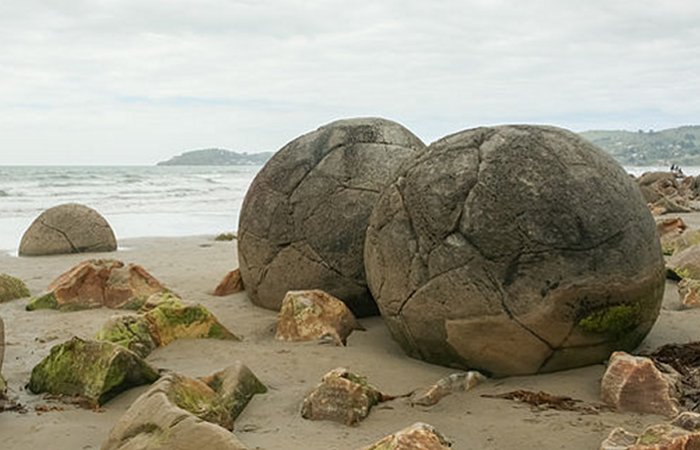
MessageToEagle.com – The beach north of Moeraki on New Zealand’s South Island is strewn with large, near-spherical boulders with bizarre cracked shells.
There are over 50 boulders on the beach, which range in size from 0.5m to just over 2.2m but can also be up to 3 meters wide.
Inside the boulders are numerous cracks, called septaria, which radiate outward from a hollow core filled with crystals.
Their origin is unclear and unexpected locations remain largely unexplained.
However, the most widely accepted scientific view is that they are mineral concretions – hard masses that formed 60 million years ago in mudstones—layers of softer sedimentary rocks (rocks which are laid down in oceans, lakes or rivers).
There, gradual erosion exposes and releases the boulders, which eventually roll down onto the beach.
People ask questions: why are they so perfectly round? Where did they come from? Are they some kind of fossils? Or perhaps alien eggs or strange unknown to humans energy storage devices?
The Maori people relate the remarkable spherical boulders to the wreck of the great canoe Arai Te Uru. As it was travelling south, the canoe foundered in a storm near Matakaea (Shag Point).
Its cargo was washed up on the nearby beaches – the round food baskets and water gourds are TeKai Hinaki (the Moeraki Boulders), while the seed kumara (sweet potatoes) are the irregularly shaped boulders further south.
The boulders and their origins continue to fascinate tourists, geologists and folklorists.
They have been also found in China, Israel and in Saint-André-de-Rosans in the Hautes-Alpes, France and Champ Island located in the central area of Franz Josef Land, Russia. Those found at Cape Triest are comparable Moeraki boulders in New Zealand. Other stone balls have been found in the village of Boguchanka in the north of Irkutsk region.
Diego Delso – CC BY-SA 3.0
The Moeraki Boulders are unique to New Zealand but not to the world. For example, boulders – 3 meters in diameter – have been found in the USA at Cannonball River within Morton and Sioux Counties of North Dakota, while boulders 4-6m across exist at the Frontier Formation in northeast Utah and central Wyoming.
Perhaps no other rocks found in Ohio generate so much public interest and curiosity than the large carbonate spheres, known as concretions, that weather out of the Devonian-age Ohio Shale. Along the outcrop belt of the Ohio Shale from Adams County on the Ohio River northward to Lake Erie, these orange-colored globes are a familiar sight as garden and yard ornaments and driveway markers.
Many of them reach 9 feet or more in diameter. There is much speculation on the origin of these giant formations.
The nature forms spherical fantastic stone formations. The geological process that originates them can last millions of years.
Copyright © MessageToEagle.com. All rights reserved. This material may not be published, broadcast, rewritten or redistributed in whole or part without the express written permission of MessageToEagle.com
Related Posts
-
 Monster Black Holes 10 Billion Times Greater Than The Sun
-
 Hyponatremia: Danger Of Drinking Too Much Water In A Short Time
-
 Bizarre Alien Planets Made Of Exotic Hot Ice
-
 What Is The Color Of The Sky On An Exoplanet?
-
 A Diamond Bigger Than Earth Is Located In The Constellation Of Cancer
-
 Extraordinary Photographic Memory Of Genius Stephen Wiltshire
-
 Kondyor Massif: A Remarkable Perfectly Round Natural Formation
-
 Earth Compared To A Giant Solar Flare Eruption
-
 Cruithne – Strange And Fascinating Celestial Body Dancing Back And Forth
-
 Kuuk Thaayorre Language Uses Cardinal-Direction To Define Space

