
Past Climate Change To Blame For Antarctica’s Giant Underwater Landslides – New Study
Eddie Gonzales Jr. – MessageToEagle.com – Scientists have discovered the cause of giant underwater landslides in Antarctica, which they believe could have generated tsunami waves that stretched across the Southern Ocean.
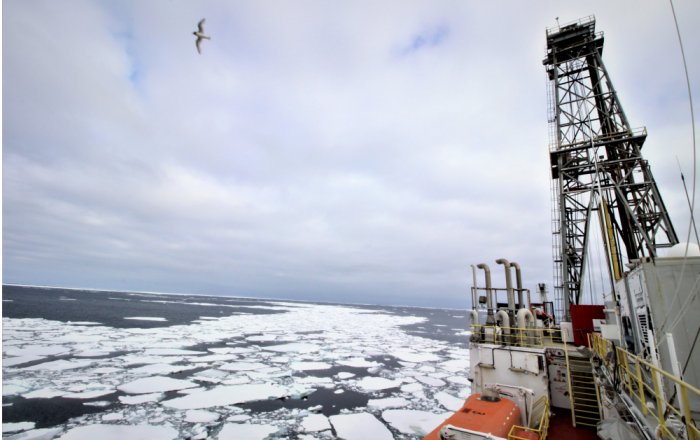
The research vessel JOIDES Resolution surrounded by sea ice as it approaches Antarctica’s eastern Ross Sea during International Ocean Discovery Program (IODP) Expedition 374. Credit: Jenny Gales/University of Plymouth
An international team of researchers has uncovered layers of weak, fossilized and biologically-rich sediments hundreds of meters beneath the sea floor.
These formed beneath extensive areas of underwater landslides, many of which cut more than 100 meters into the seabed.
Writing in Nature Communications, the scientists say these weak layers—made up of historic biological material—made the area susceptible to failure in the face of earthquakes and other seismic activity.
They also highlight that the layers formed at a time when temperatures in Antarctica were up to 3°C warmer than they are today, when sea levels were higher and ice sheets much smaller than at present.
With the planet currently going through a period of extensive climate change—once again including warmer waters, rising sea levels and shrinking ice sheets—researchers believe there is the potential for such incidents to be replicated.
Through analyzing the effects of past underwater landslides, they say future seismic events off the coast of Antarctica might again pose a risk of tsunami waves reaching the shores of South America, New Zealand and South East Asia.
The landslides were discovered in the eastern Ross Sea in 2017 by an international team of scientists during the Italian ODYSSEA expedition.
Scientists revisited the area in 2018 as part of the International Ocean Discovery Program (IODP) Expedition 374 where they collected sediment cores extending hundreds of meters beneath the sea floor.
By analyzing those samples, they found microscopic fossils which painted a picture of what the climate would have been like in the region millions of years ago and how it created the weak layers deep under the Ross Sea.
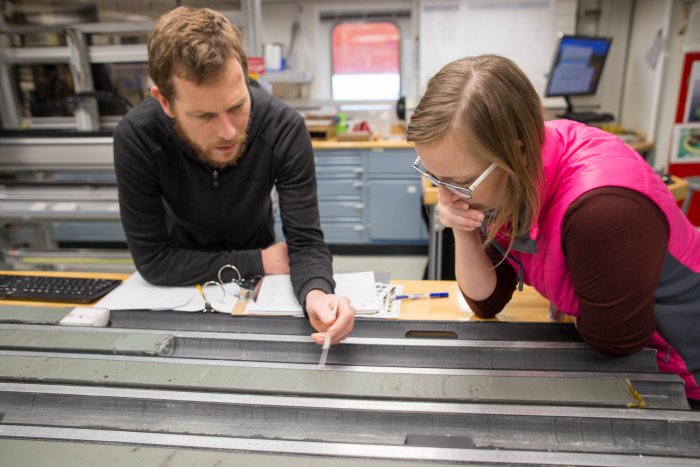
Professor Rob McKay (Director of the Antarctic Research Centre at Victoria University of Wellington and co-chief scientist of IODP Expedition 374) and Dr Jenny Gales (Lecturer in Hydrography and Ocean Exploration at the University of Plymouth) examine the half-section of a core recovered from the Antarctic seabed. Credit: Justin Dodd
The new study was led by Dr. Jenny Gales, Lecturer in Hydrography and Ocean Exploration at the University of Plymouth, and part of IODP Expedition 374.
She said, “Submarine landslides are a major geohazard with the potential to trigger tsunamis that can lead to huge loss of life. The landslides can also destroy infrastructure including subsea cables, meaning future such events would create a wide range of economic and social impacts. Thanks to exceptional preservation of the sediments beneath the sea floor, we have for the first time been able to show what caused these historical landslides in this region of Antarctica and also indicate the impact of such events in the future. Our findings highlight how we urgently need to enhance our understanding of how global climate change might influence the stability of these regions and potential for future tsunamis.”
Professor Rob McKay, Director of the Antarctic Research Centre at Victoria University of Wellington and co-chief scientist of IODP Expedition 374, added, “The main aim of our IODP drilling project in 2018 was to understand the influence that warming climate and oceans have had on melting Antarctica’s ice sheets in the past in order to understand its future response.
However, when Dr. Gales and her colleagues on board the OGS Explora mapped these huge scarps and landslides the year before, it was quite a revelation to us to see how the past changes in climates we were studying from drilling were directly linked to submarine landslide events of this magnitude. We did not expect to see this, and it is a potential hazard that certainly warrants further investigation.”
Laura De Santis, a researcher at the National Institute of Oceanography and Applied Geophysics in Italy, and also co-chief scientist of IODP Expedition 374, explained, “The sediment cores we analyzed were obtained as part of IODP, the international sea floor scientific drilling project that has been active in the field of geoscience for over 50 years. The project aims to explore the history of planet Earth, including ocean currents, climate change, marine life and mineral deposits, by studying sediments and rocks beneath the sea floor.”
Jan Sverre Laberg, from The Arctic University of Norway, Tromsø, said, “Giant submarine landslides have occurred both on southern and northern high latitude continental margins, including the Antarctic and Norwegian continental margins. More knowledge on these events in Antarctica will also be relevant for submarine geohazard evaluation offshore Norway.”
Dr. Amelia Shevenell, Associate Professor of Geological Oceanography at University of South Florida, College of Marine Science, noted,
“This study illustrates the importance of scientific ocean drilling and marine geology for understanding both past climate change and identifying regions susceptible to natural hazards to inform infrastructure decisions. Large landslides along the Antarctic margin have the potential to trigger tsunamis, which may result in substantial loss of life far from their origin. Further, national Antarctic programs are investigating the possibility of installing submarine cables to improve communications from Antarctic research bases.
Our study, from the slope of the Ross Sea, is located seaward of major national and international research stations, indicating that marine geological and geophysical feasibility studies are essential to the success of these projects and should be completed early in the development process, before countries invest in and depend on this communication infrastructure.”
Written by Eddie Gonzales Jr. – MessageToEagle.com Staff
Related Posts
-
 Unexplained Increase Of Radioactive Isotope Detected In The Atmosphere Over Europe Baffles Scientists
-
 Giant Viruses Are Ancient Living Organisms That Could Rewrite History Of Life On Earth
-
 New Atlas Says Most Glaciers Hold Less Ice Than Thought
-
 New Cause Of Melting Antarctic Ice Shelves – Identified
-
 As Earth’s Population Heads To 10 Billion, Does Anything Australians Do On Climate Change Matter?
-
 Why Do Mass Extinctions Occur And How Can We Prevent Them?
-
 Did An Extraterrestrial Object Hit The Earth And Trigger An Ancient Warming Period?
-
 How Plants Are Working Hard For Our Planet
-
 Huge 800,000-Year-Old Crater Buried Beneath Lava In Laos – May Have Been Found
-
 Plate Tectonics And Major Transitions In Earth’s Atmosphere And Oceans – Linked

