
Collision Between The Milky Way And Andromeda Galaxy
Question: When will the Miky Way and Andromeda Galaxy collide?
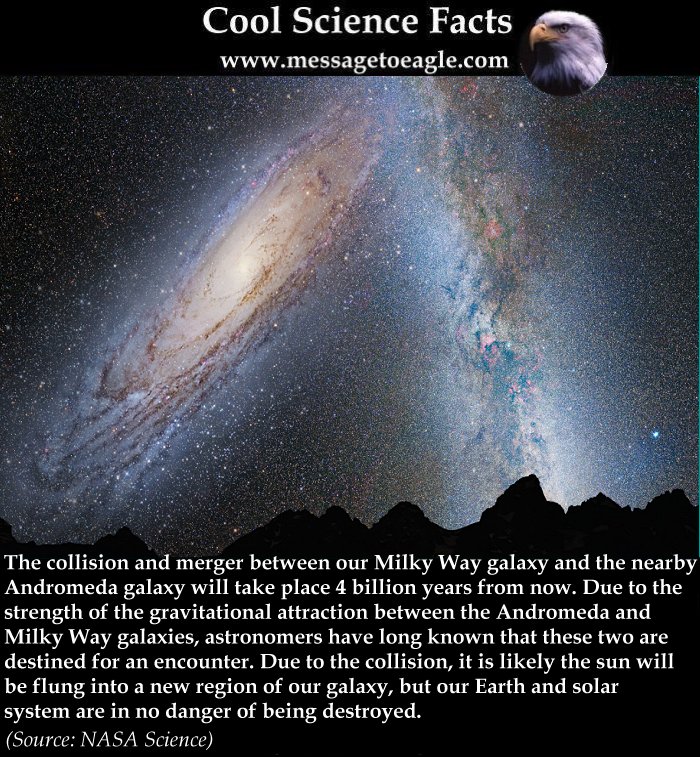
Answer: The collision and merger between our Milky Way galaxy and the nearby Andromeda galaxy will take place 4 billion years from now.
The Andromeda and Milky Way galaxies are, in fact, the two most massive galaxies in the Local Group of about 30 to 50 galaxies travelling through space as a collection that is approximately 10 million light-years across.
Due to the strength of the gravitational attraction between the Andromeda and Milky Way galaxies, astronomers have long known that these two are destined for an encounter.
Due to the collision, it is likely the sun will be flung into a new region of our galaxy, but our Earth and solar system are in no danger of being destroyed.
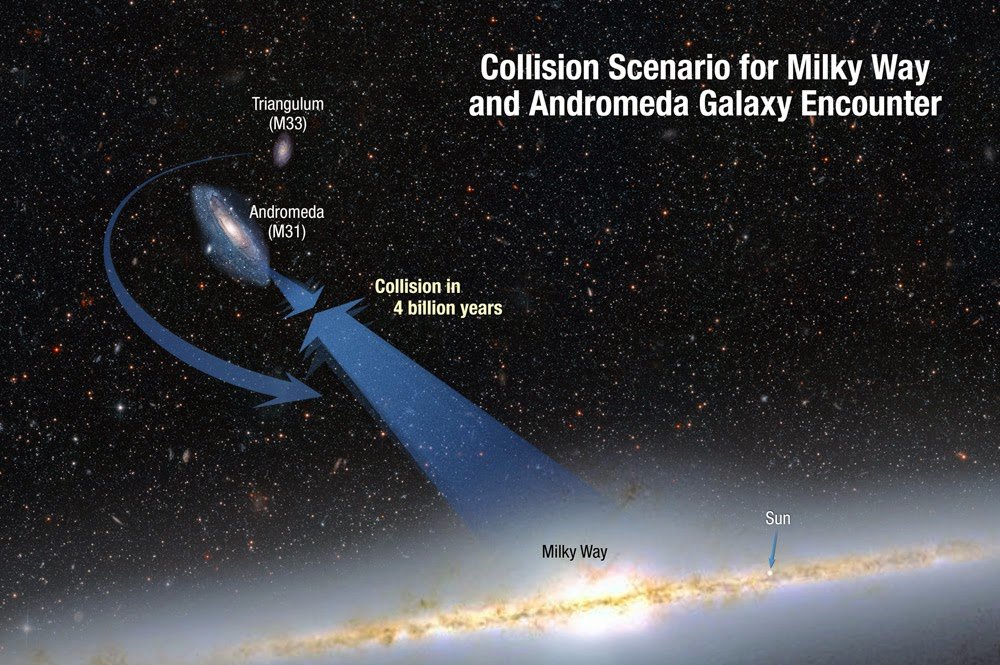
Andromeda (also known as M31) is now 2.5 million light-years away, but it is inevitably approaching the Milky Way under the mutual pull of gravity between the two galaxies and the invisible dark matter that surrounds them both.
Although the galaxies will plow into each other, stars inside each galaxy are so far apart that they will not collide with other stars during the encounter. However, the stars will be thrown into different orbits around the new galactic center. Simulations show that our solar system will probably be tossed much farther from the galactic core than it is today.
Andromeda and Milky Way are both spiral galaxies and when they collide, an elliptical galaxy – nicknamed Milkomeda – will be formed.
What has remained unknown, however, is whether this encounter will be a head-on collision a miss or a miss, glancing blow.
The timing for the collision depends much on Andromeda’s tangential or lateral, motion to the Milky Way. For now, astronomers cannot measure this motion because it’s too slow, to detect with the available telescopes and processing techniques of the past.
MessageToEagle.com
source: NASA Science
Related Posts
-
 Tough Bacteria That Turns Toxic Chemicals Into 24-Karat Gold
-
 Moths Are Masters Of Disguise
-
 Why Do Chameleons Change Colors In Unusual Ways?
-
 Ubari: Beautiful Oasis In The Middle Of The Desert In Libya
-
 Quasars: Most Energetic, Distant And Extremely Luminous Astronomical Objects
-
 Mariana Trench: Deepest Part Of The World’s Oceans
-
 Wim Hof: The Iceman Who Can Withstand Extreme Cold
-
 What Would Really Happen If We Tried To Send Humans To Venus?
-
 ‘Artificial Trees’ Will Absorb Carbon Dioxide 1,000 Times More Effective Than A Regular Tree
-
 Huge Molten Iron River Is Moving Rapidly Beneath Our Feet – It’s Heading Towards Europe

