
How Do Humans See Colors?
MessageToEagle.com – All the colors we see are an effect of light. Our eyes detect light particles (photons) because they hit our retinas.
There are special cells in our retinas, which are sensitive to color. These cells (called cones) send messages about color to our brains, which have the ability to process these messages and thus to receive colors.
We have about six million cones and rods in each retina, so together our eyes have at their disposal – 12 million cones. They react to light and tell our brains what colors we see.
The cones are densely packed in a small, tiny place “fovea centralis” located at the back of our eyes. The cones in our eyes are of three types and respond most strongly to the colors red, green and blue, in that order and they work best in light-rich environments.
From these three colors, and by adding and mixing in information about shading and tone, come the ten million colors humans can see.
Cones work in bright light and we can see color during the day with several details (the leaves on a tree, the fine print in a newspaper or color details in a puzzle). When it’s dark the cones in our eyes – turn off and therefore, we have difficulties to see color at night.

NOTE: Some people cannot see some or all colors and this condition is known as color blindness.
Color blindness (usually regarding red/green) occurs when some of the cones in the eye’s retina are not working properly or may be missing (an injury or disease, for example.) Most color blindness however, is inherited from birth.
Certainly our eyes are an amazing piece of engineering but they cannot see everything, for example, they are only able to see light of certain wavelengths – and it’s blind to much more light than it can see.
See also:
Pirahã: Weird Language That Lacks Words For Numbers And Colors
What Colors Can Newborn Babies See?
Face Blindness Makes You Surrounded By Strangers: Why Some People Cannot Recognize Faces?
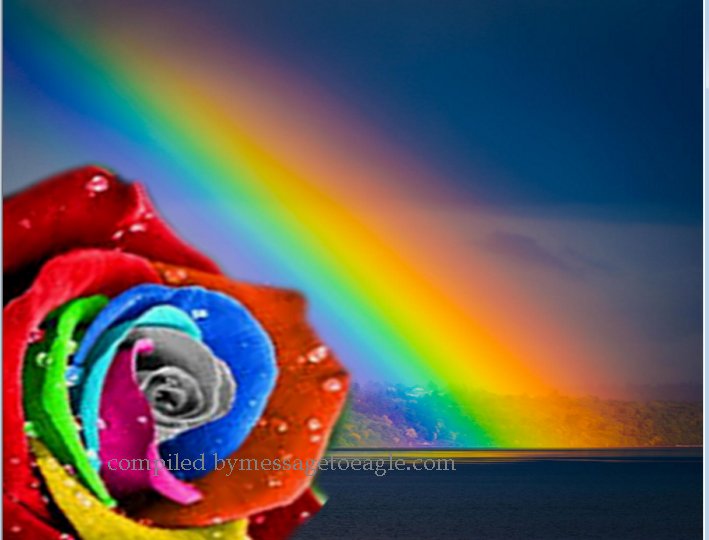
Visible light that can be detected by human eyes is only light with wavelengths of about 400 nanometres to 700 nanometers, which describe every color of the rainbow, from red to violet – all the light that our eyes are able to see.
So, we can say we see much because we are able to see the rainbow of colors.
At the same time, we have to remember that the rainbows in the sky are – unfortunately – only a very tiny part of incredibly rich cosmic spectrum of light.
This spectrum is invisible to human eye!
MessageToEagle.com
Expand for referencesReferences:
Schacter D. Daniel G. Wegner D. Hood B. Psychology
Simon Brown S.Street S, Watkins L. Color and the Moving Image
Related Posts
-
 All Hail Mimas: Our ‘Death Star’ Moon
-
 Physicists Found Link Between Einstein’s Equivalence Principle And Quantum Physics
-
 Vatican Announces The Death Of Pope Francis On Easter Monday Aged 88
-
 Distant And Second Oldest Galaxy Detected By LMT That Watches Formation Of Stars, Galaxies And Planets
-
 Can You Create A Universe From Nothing?
-
 Famous Giant’s Causeway In Northern Ireland And Devils Postpile (USA) Were Formed Around 840-890 ˚C
-
 Unusual Organisms Living On Pandora – A Fictional Alien World That Could Be Real
-
 Cruithne – Strange And Fascinating Celestial Body Dancing Back And Forth
-
 Small Magellanic Cloud: Most Detailed Radio Image Of Nearby Dwarf Galaxy Created
-
 Tristan da Cunha: The Remotest Inhabited Island

