
Remarkable Cosmic Bow-And-Arrow-Shaped Radio Galaxy – Discovered
Eddie Gonzales Jr. – MessageToEagle.com – An international team led by Dr Pratik Dabhade from the National Center for Nuclear Research (NCBJ) has found a striking radio galaxy shaped like a bow and arrow, with a huge arc stretching almost 1.8 million light-years.
The newly identified system has a “highly unusual” and asymmetric structure which is unlike those seen in standard radio galaxies.
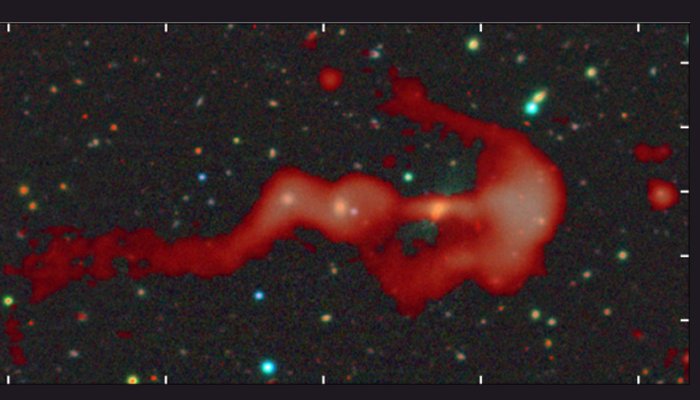
RAD-BAARG radio galaxy, with the 144 MHz radio image from the LOFAR radio telescope shown in red and the optical image from the BASS survey shown in RGB colour. Credit: Hota et al. (2026) and the RAD@home Collaboratory – CC BY 4.0
It was detected by an international team of researchers working with RAD@home Astronomy Collaboratory for citizen science research in India using ultra-sensitive images from the Low-Frequency Array (LOFAR) radio telescope.
They say it may represent one of the clearest known radio signatures of a giant bow shock generated by a galaxy falling supersonically into a cluster environment.
“The structure of this source is unlike that of any radio galaxy I have seen in the last 25 years,” said lead author Dr Ananda Hota, Founder, Director and Principal Investigator of RAD@home Astronomy Collaboratory.
“It’s remarkable morphology appears to display signatures of interaction between relativistic radio plasma and a large-scale shock generated during the galaxy’s infall into a nearby cluster environment.”
The discovery of the source – named RAD-BAARG (Bow-And-Arrow Radio Galaxy) – was made using data from the LOFAR Two-metre Sky Survey (LoTSS), one of the deepest radio surveys ever conducted at low frequencies.
Radio galaxies are powered by supermassive black holes located at the centres of galaxies which launch enormous jets of relativistic magnetised plasma into intergalactic space.
In RAD-BAARG, the researchers say one of the jets appears to interact with a large bow shock-like structure formed as the host galaxy falls through the surrounding hot gas toward a nearby cluster of galaxies.
Similar to the shockwave formed ahead of a supersonic aircraft, a galaxy moving faster than the speed of sound in the surrounding intracluster medium can compress the ambient gas and generate a large-scale shock front.
The radio-emitting plasma from RAD-BAARG appears to illuminate this otherwise extremely faint structure, making it visible in low-frequency radio images, according to the team. The western side of the source contains a narrow jet feeding a sector-shaped emission region and a giant arc-like feature extending over nearly 560 kiloparsecs (1.8 million light years).
On the opposite side, the jet develops a distorted S-shaped morphology followed by a faint offset tail extending to almost 600 kiloparsecs. The overall structure suggests strong interaction between the radio plasma and the surrounding large-scale environment.
The research team found that the host galaxy resides within a dynamically complex environment containing nearby cluster-scale systems at similar distances.
The observed morphology is consistent with interaction between the radio jets and large-scale environmental gradients, bulk gas motions, and possible shock-related compression associated with the galaxy’s infall.
Although theoretical studies and computer simulations have long predicted bow shocks around infalling galaxies, detecting them directly has proven extremely difficult because the surrounding gas is extraordinarily diffuse and faint.
A few candidate systems have previously been hinted at in X-ray observations, but RAD-BAARG provides an unusually detailed radio view of such a phenomenon.
Co-lead author Dr Pratik Dabhade, from the National Centre for Nuclear Research in Poland, said: “BAARG is exciting not just because of its striking bow-and-arrow shape, but because it sits in a complex multi-halo environment where gas flows, infall, and possible shocks can reshape radio plasma.
“LOFAR allows us to see this faint, low-surface-brightness emission in remarkable detail. With LoTSS DR3 and the future Square Kilometre Array Observatory (SKAO), we may find many more systems where radio galaxies reveal otherwise invisible interactions between jets, galaxies, and their environments.”
Another lead author Dr Shubhrangshu Ghosh, of SRM University Sikkim in India, said: “The reported observation reveals the first direct imaging of characteristic arc-shape morphology in radio frequency in regard to supersonically infalling radio-galaxy (most likely) onto a cluster medium – a spectacular textbook example of large bow-shock.
“Discovery of more such sources and their study during the SKAO era will provide much deeper insight about jet-ambient medium interaction and consequent feedback processes.”
The unusual source was initially noticed by RAD@home citizen scientist Pranim Limbo while inspecting LOFAR survey images.
Coming from a remote Himalayan hill region and without access to a major astronomy institute, the discovery highlights the power of collaboratory-style citizen science research in enabling university students and motivated learners to take part in frontline astronomical research.
Since 2013, RAD@home has trained participants across India to analyse astronomical data from world-class telescopes and contribute to professional scientific discoveries irrespective of their geographic or institutional backgrounds.
The discovery also points toward exciting future possibilities for next-generation radio astronomy facilities such as the SKAO, which is currently under construction and expected to become the world’s most powerful radio telescope.
Written by Eddie Gonzales Jr. – MessageToEagle.com Staff Writer
Related Posts
-
 Unraveling The Mystery Of Brown Dwarfs
-
 Signals From Black Hole Consuming Star Located 300 Million Light Years Away
-
 New Model For The Universe May Solve The Enigma Of Dark Energy
-
 Earth Is 2,000 Light-Years Closer To Supermassive Black Hole – New Map Shows
-
 Astronomers Have Identified A Supermassive Black Hole In Motion
-
 Why Are Moon Titan’s Large Islands Disappearing And Later Re-Appearing?
-
 HETDEX Reveals Galaxy Gold Mine In First Large Survey
-
 Sun’s Magnetic Field Is Ten Times Stronger Than Previously Believed
-
 The Upside-Down Orbits Of A Multi-Planetary System
-
 Powerful Auroras Of Jupiter Are A Mystery – New Data From NASA’s Juno Spacecraft Reveals

