
Using AI To Better Understand Neutron Star Mergers
Eddie Gonzales Jr. – MessageToEagle.com – Using a novel machine-learning-based simulation model, an international research team at GSI/FAIR has gained a deeper understanding of element formation in stellar events such as neutron star mergers.
For the first time, the scientists used deep learning with a neural network to model the energy release during r-process nucleosynthesis in hydrodynamic simulations.
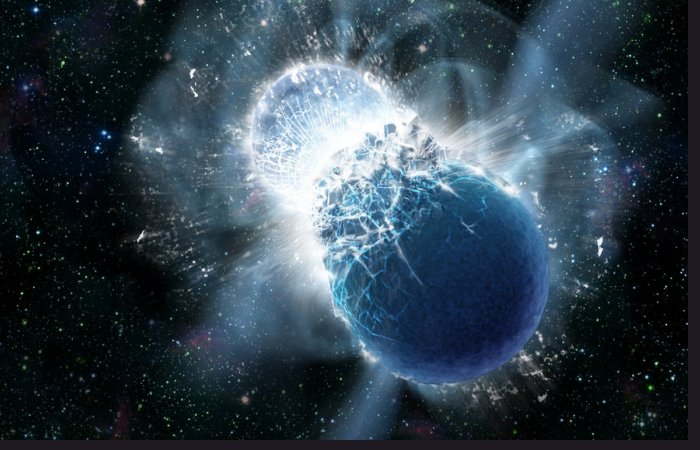
Artist’s imppression of a neutron star merger – Image credit: Dana Berry, SkyWorks Digital, Inc.
Many of the chemical elements we know are created in massive stellar events such as the explosions of stars or neutron star mergers. These events release incredible amounts of energy which allow for the production of heavy nuclides. One key nuclear production process is the so-called rapid neutron-capture (r-process), in which free neutrons are captured by existing nuclei and convert into protons — thus creating larger, heavier atomic nuclei.
“Researchers around the world strive to make these complex reactions understandable through theoretical simulations. However, modeling all parameters requires incredible computing power, which is why the models often have to be simplified,” says Dr. Oliver Just, first author of the publication and researcher in the department “Nuclear Astrophysics & Structure” at GSI/FAIR, in a press release
“Our new model RHINE, which uses artificial intelligence, offers an efficient alternative.”
RHINE (r-process heating implementation in hydrodynamic simulations with neural networks) uses machine learning (ML) — specifically, a neural network based on deep learning — to describe the energy release from nuclear reactions in the r-process in hydrodynamic simulations of the events. This “heating” could have a significant impact on the dynamics and velocity distribution of the material ejected by the explosion and thus also on the electromagnetic radiation which, in the case of neutron star mergers, can be observed as a so-called kilonova.
“First the ML models are trained using a large number of reference calculations produced with a full set of nuclear reactions. Subsequently, the models are adopted in running hydrodynamical simulations to approximate the heating rates during the r-process with minimal effort,” Dr. Zewei Xiong explains the method. He is also a scientist in GSI/FAIR’s department “Nuclear Astrophysics & Structure” and played a key role in the design of the ML models.
“With detailed comparisons, we validated our ML scheme against reference data. The high degree of agreement suggests that the use of ML models can save a tremendous amount of computing time. We also deduced from the results that r-process heating is an important effect that should be better accounted for in future modeling.”
In the future, thanks to the use of the new RHINE model, more detailed simulations could be conducted which could directly link the results of experiments at the future FAIR facility with observations of stellar explosions and neutron star mergers.
Written by Eddie Gonzales Jr. – MessageToEagle.com Staff Writer
Related Posts
-
 Black Hole’s Wobbling Shadow – Revealed By A New Analysis
-
 Webb Reveals New Structures Within Iconic Supernova
-
 Possible Radio Signal From Exoplanet In The Constellation Boötes – Detected
-
 Despite Hostile Environment Pulsar Could Host Habitable Planets – New Study
-
 Spiral Galaxy Messier 77 (NGC 1068) As Seen By ALMA And The Hubble Space Telescope
-
 New Surprises On Galaxy Organic Molecules Near Black Holes – Revealed By JWST
-
 Methane Emission On A Cold Brown Dwarf – Uncovered
-
 Mystery At the Center Of The Milky Way Solved
-
 Researchers Are One Step Closer To Explain Dimming Of Mysterious ‘Tabby’s Star’
-
 Astronomers Explain Origin Of Elusive Ultradiffuse Galaxies

