
Mapping Of Galactic Bar In The Milky Way By Gaia
Eddie Gonzales Jr. – MessageToEagle.com – Researchers created a map of the bar-shaped collection of stars at the center of our Milky Way galaxy, by combining ESA’s Gaia mission’s second data release (DR2) with complementary observations by ground- and space-based telescopes, the catalog
The unprecedented catalog contains the brightness, positions, distance indicators and motions across the sky for more than one billion stars in our Milky Way galaxy, along with information about other celestial bodies.
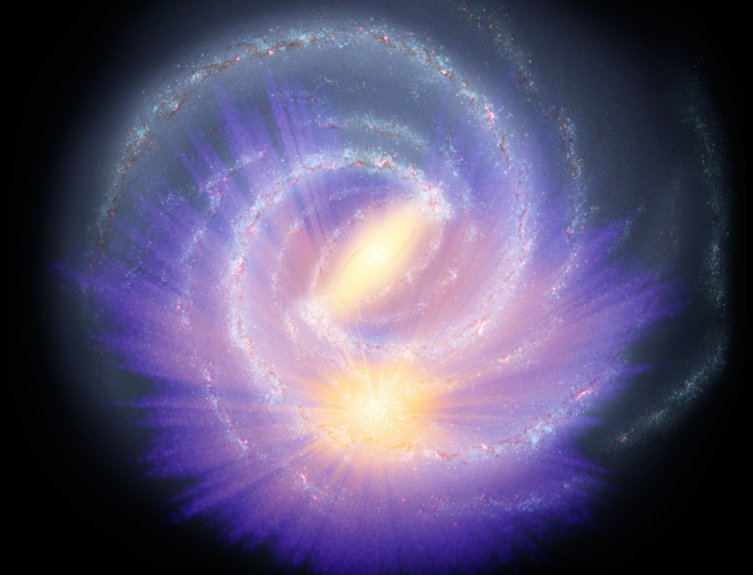 Display of Gaia data combined with other surveys and StarHorse code over an illustration of the Milky Way. A bar structure is clearly visible in the middle. Credit: NASA/JPL-Caltech/R. Hurt; Starhorse Overlay: A. Khalatyan
“We looked in particular at two of the stellar parameters contained in the Gaia data: the surface temperature of stars and the ‘extinction’, which is basically a measure of how much dust there is between us and the stars, obscuring their light and making it appear redder,” Friedrich Anders ICCUB member and lead author of the new study, conducted by researchers from the Institute of Science Cosmos of the University of Barcelona and from the Leibniz Institute for Astrophysics Potsdam (Germany), said in a press release.
“These two parameters are interconnected, but we can estimate them independently by adding extra information obtained by peering through the dust with infrared observations.”
“With the second Gaia data release, we could probe a radius around the Sun of about 6500 light years, but with our new catalogue, we can extend this ‘Gaia sphere’ by three or four times, reaching out to the centre of the Milky Way,” explains co-author Cristina Chiappini from Leibniz Institute for Astrophysics Potsdam, Germany, where the project was coordinated.
At the center of our galaxy, the data clearly reveals a large, elongated feature in the three-dimensional distribution of stars: the galactic bar.
“We know the Milky Way has a bar, like other barred spiral galaxies, but so far we only had indirect indications from the motions of stars and gas, or from star counts in infrared surveys. This is the first time that we see the galactic bar in three-dimensional space, based on geometric measurements of stellar distances,” says Friedrich Anders.
“Ultimately, we are interested in galactic archaeology: we want to reconstruct how the Milky Way formed and evolved, and to do so we have to understand the history of each and every one of its components,” adds Cristina Chiappini.
Written by Eddie Gonzales Jr. – MessageToEagle.com Staff
Related Posts
-
 Earth And Moon Are Not Identical Oxygen Twins – New Study
-
 Japanese Jumping Robotic Rovers Deliver Amazing Images From Surface Of Asteroid Ryugu
-
 ‘Lonely Cloud’ Bigger Than Milky Way Discovered In A Galaxy ‘No-Man’s Land’
-
 Hubble In Safe Mode As Gyro Issues Are Diagnosed – Get Well Soon Hubble!
-
 Cosmic Secrets Of Asteroids And Meteorites Revealed In New Study
-
 NASA’s Juno Solves 39-Year Old Enigma Of Jupiter Lightning
-
 Unusual Planet Evolving Into Hot Jupiter – Spotted
-
 NASA’s Webb Telescope – Ready For Instrument Commissioning
-
 Ancient Stars’ Orbits Prompt Rethink Theories On Milky Way’s Evolution
-
 How Long Is A Day On Venus? Scientists Crack Mysteries Of Our Closest Neighbor

